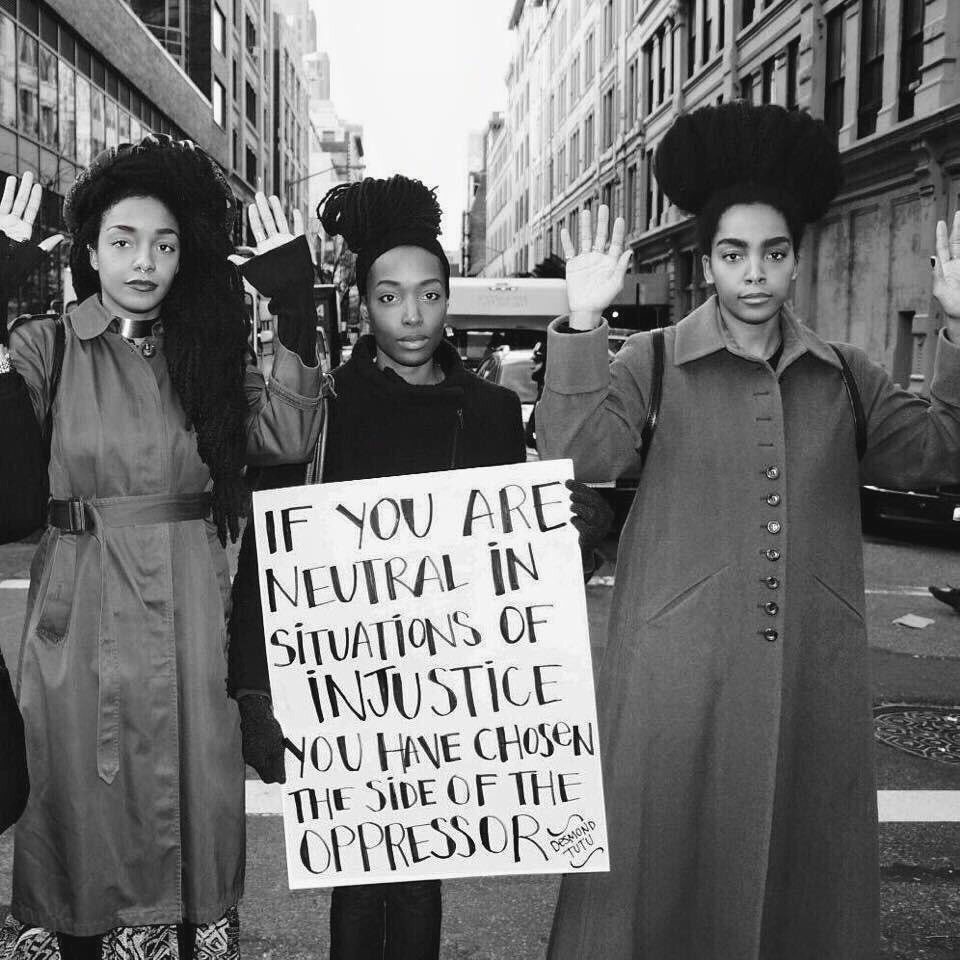
Fellow white people: this is on us

I regret I don’t know who should get the credit for this powerful photo. The quote is by Archbishop Desmond Tutu.

Like many of you, I’ve been deeply shaken by the events of the last few days. The murders. The videos. The soul-deep anger and despair my black friends describe. The dread they feel when they watch their children walk out the front door.

Fellow white people, this is on us.

I’m not saying you and I are personally responsible. I’m saying white people have the power to change this.

Continue reading

They Keep Killing People Like Me

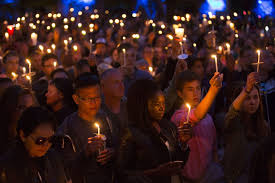
candles toronto

They’re killing people like me.

That’s the thought that crossed my mind on Sunday morning as I began to see reports about the massacre at the LGBT club in Orlando. The feeling was stunning – and familiar.

Like all Jewish children born into the shadow of the Holocaust in the 1950s, I had to come to grips with that idea early. After all, what separated me from the millions of people slaughtered simply because they were Jewish like me? An ocean. A handful of years. Not much, really.

In 1970, that feeling found me again, when armed troops fired on college students demonstrating against the Vietnam war on their own campus at Kent State. National Guardsmen killed four students and wounded nine others.

Photo: John Filo

Photo: John Filo

I was only 16, but I hoped to go to college soon. I knew I would be exactly the kind of student who would have been out on that hilly field, chanting and shouting and waving signs against the war. And the government – my government – would have ordered its soldiers to drop on one knee and shoot people like me.

Ten days later, in Mississippi, it happened again. Local police killed two students and wounded twelve others. But I didn’t have that “they’re killing my people” feeling, because I didn’t learn about the Jackson State massacre for years. Why? They were African American students at an historically black college. Their deaths didn’t get anywhere near the media attention of the four white students in Ohio.

After Stonewall

Five years after Stonewall, I came out as a lesbian into the embrace of a vibrant women’s movement. In Chicago in the 1970s there were plenty of places I could go to be my angry, idealistic, lesbian-feminist self. There were coffeehouses where we listened to music, back rooms where we held our endless meetings, chilly basements where we drafted our newsletters on clacking typewriters, cramped kitchens where we imagined our liberated future.

But I also needed the bars, although I wasn’t a drinker. Because sometimes you just want to be together. Be safe. Be recognized. Just be. It may seem strange, even before Orlando, to think of bars as places of refuge. My straight women friends talk about – and organize about – how they get harassed and accosted in bars. But the lesbian bars of my youth shared the one element most conducive to women’s safety: no men.

We’re all alone

I remember slow dancing with my girlfriend as Rita Coolidge sang “We’re All Alone.” It was a summer evening, before the crowds descended, and the quiet bar on Chicago’s north side looked shabby in the fading daylight. We didn’t care. We were young, our souls aflame with romance and revolution, and Rita Coolidge was telling us to “Let it out, let it all begin. Learn how to pretend.”

Of course, how to pretend was one thing lesbians of my generation did not need to learn. Most of us had been pretending all our lives. And when we stepped out of that bar, we would once again have to pull on the false self we showed to the unwelcoming world.

The killing continued

Still, they kept killing people like me. Sometimes they killed with silence, like the gigantic national shrug that met the AIDS crisis. I believe that shrug launched the united LGBTQ movement, when lesbians stepped up to take care of our dying brothers because no one else gave a damn. Before that, the gay men I knew had been pushing for civil rights while the lesbians fought for women’s liberation, and we collaborated only briefly to confront shared foes.

The movement shifted but the killing continued. When a man who was enraged to see two women together murdered Rebecca Wight and injured her partner Claudia Brenner along the Appalachian Trail in 1988. When a gunman slaughtered 14 women engineering students in Montreal in 1989, screaming “I hate feminists!” and the media speculated on what his motive could possibly be. When Matthew Shepherd was battered, trussed and left to die in 1998. When Sakia Gunn was stabbed to death in New Jersey in 2003 because she and her girlfriend turned down her killer’s proposition. When right-wing extremists in legislatures and pulpits created the conditions in which killings can keep on happening.

Photo: Dreams Deferred: The Sakia Gunn Film Project.

Photo: Dreams Deferred: The Sakia Gunn Film Project.

Not again

The gut punch of the Orlando massacre is not new. It’s not again. Not again this grief, this anger, this fear. Not again watching politicians twist our pain to their own purposes.

After decades spent in social justice movements, I carry in my bones the history of how we got here. They keep killing people like us. So we are the ones who must join with others to rise up and create a world where no one needs to keep a running tally of who is, and is not, like us. As Marge Piercy wrote, “It starts when you say ‘we’ and know who you mean, and each day you mean one more.”

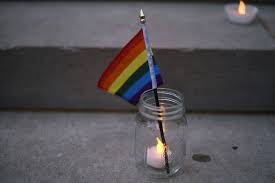
flag in candle jar

In Another Life – A novel by Julie Christine Johnson

In another life cover

For a long time I have followed Chalk the Sun, the wonderful blog by the writer Julie Christine Johnson. So when I learned she had a debut novel coming out, I knew I had to read it.

I wasn’t sure what to expect. From its pre-publication description, In Another Life seemed to be an amalgam of genres: mystery, romance and historical fiction. I knew from following Johnson online that she is a beautiful, soulful writer, and I was eager to see how her talent and sensibility translated into book-length fiction. I wasn’t disappointed.

Death and history

Still devastated by the sudden death of her husband in a mysterious accident 18 months ago, Lia Carrer leaves the U.S. and returns to the Languedoc region of southwestern France. As much as anywhere in her untethered life, this rural area with its medieval ruins is home to Lia. Her family has roots in the region, and she has close friends there.

What’s more, she is on her way to completing a PhD in history focused on the ancient religious group called the Cathars, who flourished in the region until they were massacred into extinction by the Catholic Church in the early 13th century. Lia’s scholarly research examines the Cathars’ intriguing belief in reincarnation, and the unknown truth behind the murder of a cleric in the year 1208 that proved to be a pivot point in the downfall of the Cathars and ascendance of the Catholic Church during its most bloodthirsty era.

New love and ancient questions

Lia is thrilled when an old friend, a priest who comforted her after her husband’s death, tells her that a priceless archive of original materials about the Cathars has, somewhat mysteriously, become available. Still, her life in the village isn’t all solitude and study.

She meets a photographer and embarks on a project with him, a coffee table book about the region. Their relationship is mostly business, but with confusing glints of desire. Or is it menace? Then at a party she meets a wine maker, a man with whom she had recently shared a terrifying experience in what must have been a dream or hallucination. She finds herself falling in love with him, the first time such feelings have stirred since her husband’s death.

But Lia’s notions of what is real and what could not possibly be true begin to crumble as she realizes that these three men – the priest, the photographer and the wine maker – are in her life for a reason. And that reason shatters everything she thinks she knows about history, time, and death itself, including the death of her husband.

Gorgeous writing

The first thing that must be said about In Another Life is that the writing is gorgeous. The descriptions are so lush and lovely that you can see, feel and inhale the aromas of the place, from the “dark and brooding” wines of today to the charred church timbers of the 13th century. And all this beauty is built on an edifice of rigorous erudition.

I knew little (OK, nothing) about the Cathars or the Languedoc region. I now have a much deeper sense of the area’s importance, and the dark and momentous events that took place there and shaped present-day Europe. In the Author’s Note at the end of the novel, Johnson said that as part of her research into the region she “drank its wine and whispered its language,” a description I love.

More to come

If you read In Another Life and want more, there’s good news. Julie Christine Johnson has two more novels coming out in the next couple of years. No doubt many people will be eagerly awaiting her next book: her publisher had to reprint In Another Life only three days after it was published.

Julie Christine Johnson. Photo by Al Bergstein.

Julie Christine Johnson. Photo by Al Bergstein.

A Trio of New Voices – Vintage 2016

I’m enough of a book nerd that I enjoy re-reading beloved books and finding something new to appreciate and admire each time. I’m also excited when I learn that a favorite writer is coming out with a new book.

Yet nothing matches the thrill of discovering talented new novelists. That’s what I’ve been doing the past few weeks, and I’m delighted to share with you this trio of compelling new voices.

The Longest Night by Andria Williams

Rarely do I lose sleep worrying about the fate of fictional characters. But Andria Williams’ debut novel, The Longest Night, kept me up late and troubled my dreams.

It’s 1959, the height of the cold war. Nat, a spirited young woman from California who has never seen snow, finds herself facing winter in the small Idaho town where her Army husband has been stationed. She and Paul married impulsively after a brief courtship, and now have two young children.

Secrets and silence

Nat is proud of Paul’s job working on the Army’s nuclear reactor and eager to be his helpmate. His reserve had always made her cherish their intimacy, feeling “whatever strange majesty was in him was known to her alone.” But as his quietness grows into secrecy, so does her feeling of being trapped and isolated in a town where she knows no one yet is judged by everyone. Paul realizes his marriage is in trouble, but he has more urgent worries: something is dreadfully wrong with the nuclear reactor – and his superiors are doing everything they can to cover it up.

Based on the true history of a fatal nuclear accident, The Longest Night creates a tingling sense of foreboding on page one that only continues to build. With crisp descriptions and sharp, compelling dialogue, Williams brings to life a set of vivid characters, and the mood of a mid-century America on the cusp of the nuclear age.

Longest Night


Casualties by Elizabeth Marro

A troubled son who joins the Marines and returns from Iraq physically whole but psychologically ravaged. A loving mother who works for a military defense contractor and climbs to the top of the executive ladder at the cost of too much compromise. A moment in which everything goes terribly, irretrievably wrong.

I suppose Elizabeth Marro could have come up with a premise more certain to reel me in, but she would have had to name a character after me.

Ruth Nolan has worked hard to achieve a way of life no one in her family could even imagine – the house on the beach, the fancy car. Security. She single-handedly raised her son Robbie, a loving boy who grew into a surly youth and never quite got a grip on adult life.

Joining the Marines did indeed make a man of Robbie, but a man who couldn’t live with what he had seen and done, a man who shot himself to death as tidily as possible and left a note for his mother that said, “It wasn’t your fault.”

A gripping journey

It’s impossible for Ruth to believe that. On the last day of Robbie’s life she had noticed his eyes “shining with need,” but had still canceled their lunch together to deal with a serious work emergency. Shattered, she packs Robbie’s ashes into the fancy car and runs away from her life.

It’s here that the novel takes a surprising and ultimately rewarding turn, sending the reader on a gripping journey of grief, guilt and intimacy as Ruth careens across the country, chasing the faint glow of redemption. Casualties explores the personal and permanent costs of war, including the moral injuries suffered by those who wage war, those who love them, and – all too rarely – those who profit from it.
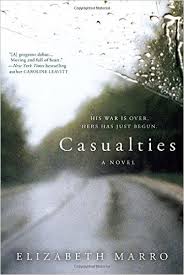
Casualties


Not a Self-Help Book: The Misadventures of Marty Wu by Yi Shun Lai

Poor Marty Wu. She finds herself in such distressing situations, and all I can do is laugh.

Marty lives in New York and has a job she hates, selling ads for a magazine she’ll never read, working for a boss who used to be her boyfriend and sometimes behaves like he still is. Despite all the self-help books Marty reads, bad things happen to her, and many are her own fault. She’s clumsy, earnest, immature and hilarious.

We get to know a lot about Marty’s inner life, because the novel is written as a series of journal entries she jots down on her way to a new, improved self. Marty has a dream to own a small costume shop that lets people shed their skins and become someone else for just a night. And she has a living nightmare in her formidable mother, who’s not only impossible to please but downright abusive.

A tightrope act

Marty’s daily life is a tightrope act so familiar to the children of immigrants, pulled between the culture of her family and the American reality she lives. When she loses her job and alienates her best friend in an escalating series of all-too-preventable stumbles, she flees to Taiwan with her mother. There Marty soaks in the support of her extended family and  uncovers family secrets that force her to take a fresh look at her mother and herself.

With its light touch, Not a Self-Help Book treats serious issues with humor and humanity. It introduces us to a heroine for a new era, a wacky, wistful, hyped-up version of our own inner anxieties.

Special note

Not a Self-Help Book: The Misadventures of Marty Wu will be published in May 2016. If you want to buy this book – and you should – pre-order it directly from the publisher, and you’ll get a 30% discount.

The novel is published by Shade Mountain Press, my own publisher. This makes Yi Shun Lai a sister of mine, although we’ve never met. Now that you know about this caveat, you should also know this: I am not a big fan of comic novels, but I recommend this one whole-heartedly.

yishunlai_cover

Update from Book World

My novel came out a little more than a year ago, and it’s still having adventures. Here are a few of them.

Authors’ Roundtable at Temple Sinai


Sinai book logo
Every year, the Women of Reform Judaism of Temple Sinai in Washington, DC hold an authors’ roundtable, which brings together some 200 book lovers for a panel discussion and then an opportunity to talk with individual authors over lunch. This year I was lucky enough to be part of the event, which included:

The discussion was expertly moderated by Lissa Muscatine, co-owner of DC’s preeminent independent bookstore, Politics and Prose. Muscatine had a long career as a journalist, and was a speechwriter and top advisor to Hillary Clinton from her years as First Lady through the 2008 election through her time as Secretary of State. Those of us on the book panel felt we could have had an entire discussion solely about Muscatine’s experiences.

There’s nothing better than talking about books and writing with people who love both. If you’re in the DC area, I suggest you check out next year’s roundtable at Temple Sinai. I’ll be there – in the audience.

Book groups!

Books that Bind book group

Books that Bind book group

I’ve been having a wonderful time meeting with book groups as they discuss Her Own Vietnam. It’s fascinating to hear readers’ responses, perspectives and insights about the novel.

Being with these book groups has reinforced something I’ve always known but can still find difficult to grasp: your novel is not a finished product. It is simply the raw material that each reader will use to create her own experience. And her experience can be something you intended, or something you never imagined, or even something you wish you’d thought of. In that way, each reader turns your book into her own.

Letters from readers

Photo: Zach Pierce mu-43dotcom

Photo: Zach Pierce mu-43dotcom

Every now and then a reader will take the time to send me a personal note about their experience with Her Own Vietnam. This one is from a man who was in one of the book groups I visited. He is a West Point graduate who served in Vietnam. Everyone else in his class also deployed to Vietnam, many of them for multiple tours. Not all of them came home.

Here is his letter.

“I wanted to say how much I enjoyed reading your book and even more enjoyed the opportunity to meet you in person and be a part of the [book group] discussion. I have read the book twice and have very much appreciated it as a thoughtful and compelling description of a piece of the world that my wife and I and others affected in one way or another by the war in Vietnam experienced in the late 60s and early 70s. Those experiences were very different depending on the specific time and role, but they left a mark on those who passed through them. We were young then but grew up quickly.

“I was never in an evac hospital and my friends who were have only fragmentary recollections of their time there, but those women and men who lived that experience for a year surely had experiences that haunted them ever after that. It’s a story that has not gotten much public discussion and your book captured well what they must have felt and experienced.

“So thanks very much. There is always some strain in revisiting those times but they are always there and I find that in one way or another I revisit them several times a week – not now as traumatic memories but as experiences that color the way I look at the world.”