On rereading “Mrs. Dalloway”


Can't. Stop. Reading. Photo: David McSpadden

Can’t. Stop. Reading.
Photo: David McSpadden

Every decade or so I reread Mrs. Dalloway, the stunning 1925 novel by Virginia Woolf. Each time I find something new to admire and appreciate.

The novel takes place in London, during a single June day in 1923. World War One is over, but its impact can be felt everywhere. Clarissa Dalloway, an upper class woman in her 50’s, is preparing to throw a party. Peter Walsh, who once loved her and whom she rejected for the more predictable Richard Dalloway, has just returned to London after five years in India. A veteran is going mad in a way that makes perfect sense after the horrors of the war, and his immigrant wife is growing desperate. All of these people, and more, connect and intertwine and pull apart in unexpected ways as Clarissa Dalloway’s past and present collide.

A book for the ages – my ages

I first encountered Mrs. Dalloway when I was in college. I was intoxicated by the novel’s glittering, faceted language, its swirling points of view, its complex sentences and circuitous paragraphs.

I was also struck at 19 or 20 by the fact that this acclaimed novel dealt with something I was just beginning to discover myself: that women of all kinds sometimes fall in love with other women – intense and romantic, even when utterly chaste. The long-married Mrs. Dalloway, looking back on her years, considers the moment at 18 when Sally Seton kissed her as one of the happiest of her life. “Had that not, after all, been love?”

The first time I read the book, Clarissa Dalloway was older than my mother. Today I am older than Clarissa Dalloway, and I understand and appreciate her character in ways that were unavailable to me earlier. The discursive, stream of consciousness inner monologue; the way Clarissa’s thoughts swoop like birds through time, alighting briefly on instants in her youth, then the present day, then back to childhood; the power and presence in her daily life of people long gone – all of these are familiar to me now.

Laughing out loud

For such a serious book, which broke all kinds of narrative conventions and introduced new ways of creating character, the novel is full of wit. I laughed out loud at this caricature of myself and my activist friends, people whose “causes” had “made them callous”:

Miss Kilman would do anything for the Russians, starved herself for the Austrians, but in private inflicted positive torture, so insensible was she…[S]he was never in the room five minutes without making you feel her superiority, your inferiority; how poor she was; how rich you were; how she lived in a slum without a cushion or a bed or a rug or whatever it might be, all her soul rusted with that grievance sticking in it…

 Keeping some secrets

Despite many readings, the book has yet to yield all its secrets. For instance, why is the phrase “very upright” repeated so often and in so many contexts, starting with a description of Mrs. Dalloway herself? What is the purpose of the roses that appear in so many scenes?

Of course, there is a tremendous amount of scholarship on Virginia Woolf’s work, and it’s likely I could find the answers to my questions there. But for now I prefer to mine the novel’s meaning myself, through the slow pleasure of reading and rereading.

After all, it is not the book that changes over the years, but the reader.


The best book club book of all time

My book group has gathered every month for more than 20 years to read books by and about women. After all that time and all those books, is it possible we have agreed on a favorite?

Yes. Our favorite book club book of all time is Triangle, a novel by Katharine Weber.

The book weaves together the stories of Esther Gottesfeld, the last living survivor of the Triangle Shirtwaist factory fire of 1911; her scientist granddaughter; and a feminist researcher who asks Esther to share her memories and then listens a bit too carefully. The novel is riveting and challenging, with complex characters.

Who owns history?

Weber deftly builds both the mystery at the heart of the novel and the tense drama of the Triangle inferno. Small details that at first seem to provide only texture to the story later loom with horrifying impact.

The ending of the novel sent me racing back to the beginning with a new understanding – or at least new questions – about the plot. Triangle does not yield its insights easily, which makes it the best kind of book group selection, ripe for animated discussion.

Who owns history? The person whose story you believe.

 A tragedy and a legacy

The Triangle Shirtwaist fire took place 103 years ago this week. It was a predictable and preventable tragedy that killed 146 workers – mostly young immigrant women – at a clothing factory in New York.

Dozens of the workers leaped to their deaths from the top floors of the blazing building, an image that anyone who lived through 9/11 can conjure all too easily. Even more people burned to death, many of them trapped behind locked doors in flaming workrooms. Others crawled onto rickety fire escapes that collapsed and sent them plunging to the sidewalk.

More than 350,000 people marched in the streets of New York to mourn the garment workers. Outraged by their needless and excruciating deaths, factory workers organized and won many of the workplace safety laws we take for granted today.

A story less known

A year before the Triangle Shirtwaist fire, some 20,000 women who worked in garment factories had gone on strike to demand better wages, a shorter workweek (52 hours), and specific safety measures. These working class women, many of them Yiddish-speaking immigrants, drew the support of New York’s suffragists, some of whom were women from the city’s wealthiest families.

The suffragists raised funds for the workers, bailed them out of jail, and organized mass rallies to generate public solidarity. Across the city, factories conceded to the workers’ demands, acknowledged the unions, and improved workplace safety.

Not the Triangle Shirtwaist factory. The two owners – Max Blanck and Isaac Harris – refused to unionize and refused to address safety concerns, including workers’ calls to leave factory doors unlocked and provide functional fire escapes.

A year later, these safety issues cost 146 people their lives. But they cost the factory owners nothing – in fact, the two men profited from the tragedy. While they settled lawsuits by paying family members $75 for each lost life, the owners received insurance settlements of $400 for each worker killed. The two men went on to run other factories, accumulating and ignoring citations for the very safety violations that had led to the carnage at the Triangle Shirtwaist factory.

Haunted

It may seem we’ve strayed pretty far from the topic of favorite book club selections. But that’s the power of a good book: it takes you on a journey out of your world and into another. And with a haunting novel like Triangle, part of you is likely to remain there for a long, long time.

Triangle book cover

Are these books your cup of tea?

For a change of pace, I thought I’d stop talking about my own book and post some mini-reviews of books I’ve read lately. Some I loved. Others were, well, not my cup of tea.

Let’s start with four books I enjoyed.

These books were my cup of tea

My cup of tea! Photo: Girla Obscura

My cup of tea!
Photo: Girla Obscura

Blue Highways by William Least Heat-Moon.
In 1977 William Least Heat-Moon lost his job and his marriage, and decided to pack his truck and drive across America on small country roads – depicted on maps as the “blue highways” that trickle off from the major expressways. In his travels he meets fascinating people, explores dwindling small towns and their human history, and considers what to do with the rest of his life. Although he identifies as Native American like his father, Heat-Moon resembles his white mother, so he frequently hears the unselfconscious racism that white people share with one another. The book is a satisfying meander through territory that is by now twice-vanished: the rural towns whose singularity was already being erased by television and superhighways; and the America of 1977, still reeling from the Vietnam War and the social upheaval of the 1960s.

Margot by Jillian Cantor.
What if Margot Frank, Anne Frank’s older sister, had survived the concentration camps? What if she tried to shed her past by moving to Philadelphia and creating a new identity for herself as a non-Jewish woman named Margie Franklin? This is the premise of Cantor’s compelling and haunting novel, which takes place in 1959 just as the movie version of “The Diary of Anne Frank” sweeps across America.

The Museum of Abandoned Secrets by Oksana Zabuzhko.  
This sprawling novel takes place in modern-day Ukraine and in the Ukraine of 60 years ago. The plot hinges on the friendship between two women in today’s Ukraine: a journalist who hosts a popular TV interview program, and a respected artist who is killed in a freak car accident. Their story develops with a parallel story about a woman freedom fighter during WWII, about whom the journalist is trying to make a documentary. The novel is a bit challenging to read – the plot swirls around in time and place (some of it taking place in dreams) – but well worth it for the revelations about life in Ukraine, explorations about how people absorb or fail to absorb seismic political and cultural shifts in one lifetime, and wise observations about human nature and friendship among women.

Notes from No Man’s Land by Eula Biss.
A collection of essays about race, written by a white woman. The essays are brilliant, incisive, brave, and unpredictable, drawing surprising connections and provocative conclusions about everyday American life and the hidden and overt dynamics that bind us together and tear us apart.

Not my cup of tea

Not my cup of tea.  Photo: Ege Maltepe

Not my cup of tea.
Photo: Ege Maltepe

Here are two books that got lots of buzz and critical praise, but that I found disappointing.

Flamethrowers by Rachel Kushner.
A bold but naive young woman, known only by the city of her birth (Reno) moves to New York to be part of the cutting-edge art world in mid-1970s. What Reno loves is speed – as in skiing and riding motorcycles – and men. These two appetites get her involved with the black-sheep son of a rich Italian family that manufactures motorcycles, and ultimately in the radical politics of Italy. Despite the critical acclaim it received and the fact that on the surface this book should appeal to me strongly, I was only lukewarm about it. Reno’s passivity in her relationships with men got tiresome.

Sweet Tooth by Ian McEwen.
I’ve tried and tried to like Ian McEwen, but to no avail. While I can appreciate the clarity and precision of his prose, it has always seems soulless to me. And when his novels reveal their startling plot twists at the end, you can practically hear the Law & Order “cha-chung” sound in the background. His depiction of the inner lives of women characters is particularly unconvincing, although that actually turned out to be a strength in this book. All that being said, Sweet Tooth does have some things to recommend it. The novel is about a young university graduate who almost accidentally finds herself working for MI5, the British Secret Service, after being groomed for the job by an older professor with whom she had an affair. Her undercover task is to find and encourage with grant money the right sort of young writers whose work will provide cultural and intellectual support for the anti-communist side of the Cold War. Set in the 1970s, the novel does an excellent job of portraying the atmosphere of Britain in decline, beset by terrorism, economic woes, cultural upheaval and self-inflicted political wounds.

So many books…

I just finished reading the novel The Invention of Wings by Sue Monk Kidd (my cup of tea!) and started Redeployment by Phil Kay. Among the many, many books on my teetering “to be read” pile is The New Jim Crow by Michelle Alexander.

How do you handle the perpetual problem of so many books, so little time?

Reading Women Continued: H – Z

Read Women 2014 by Joanna Walsh

Read Women 2014 by Joanna Walsh

Continuing on the theme of reading women authors in 2014 – a mini-movement launched by the writer and illustrator Joanna Walsh – here are more selections my book group has read over the years. We read books by and about women.

Again, these books represent our collective decisions, not necessarily my personal recommendations. I’ve loved many, but not all, of them.

In a previous post, I listed authors from A – G. Scroll down to find it.

Here are authors from H – Z.

  • Haigh, Jennifer – Mrs. Kimble
  • Hamilton, Gabrielle – Blood, Bones & Butter
  • Hamilton, Jane – A Map of the World
  • Hamilton, Masha – The Camel Bookmobile
  • Harris, Joanne – Chocolat
  • Hazzard, Shirley – The Great Fire
  • Hegi, Ursula – Stones from the River
  • Heilbrun, Carol – Writing a Woman’s Life
  • Hulme, Keri – The Bone People
  • Hurston, Zora Neale – Their Eyes were Watching God
  • Huston, Nancy – Fault Lines
  • Jones, Ann – Looking for Lovedu
  • Karr, Mary – Lit
  • Kearns, Rosalie Morales – Virgins and Tricksters
  • Kerman, Piper – Orange is the New Black
  • Kingsley, Mary – Travels in West Africa
  • Kingsolver, Barbara – Flight Behavior; The Lacuna; The Poisonwood Bible; Pigs in Heaven
  • Kornblut, Ann – Notes from the Cracked Ceiling
  • Lahiri, Jhumpa – Unaccustomed Earth; The Interpreter of Maladies
  • Larson, Nella – Passing
  • LeGuin, Ursula – Left Hand of Darkness
  • Lessing, Doris – African Laughter
  • Levy, Andrea – Small Island
  • Lively, Penelope – Moon Tiger
  • Livesey, Margot – Eva Moves the Furniture
  • MacDonald, Ann Marie – Fall on Your Knees
  • Maloy, Maile – Both Ways is the Only Way I Want It
  • Markham, Beryl – West with the Wind
  • Marmon, Leslie Silk – Ceremony
  • Marshall, Brenda – Dakota, or What’s a Heaven For
  • Mason, Bobbie Ann – Feather Crowns
  • McDermott, Alice – After This; Charming Billy;
  • Messud, Claire – When the World was Steady
  • Min, Anchee – Red Azalea
  • Miner, Valerie – Trespass
  • Morrison, Toni – Paradise
  • Mujica, Barbara – Frida
  • Munro, Alice – Runaway; Too Much Happiness
  • Naslund, Sena Jeter – Ahab’s Wife
  • Naylor, Gloria – Mama Day
  • Nemirovsky, Irene – Suite Francaise
  • Nunez, Sigrid – The Last of Her Kind
  • O’Brien, Edna – Country Girl; The Country Girls Trilogy
  • O’Connor, Flannery – Three by Flannery O’Connor
  • O’Faolain, Naula – Are You Somebody?
  • Orleans, Susan – The Orchid Thief
  • Otsuka, Julie – The Buddha in the Attic
  • Ozeki, Ruth – My Year of Meats
  • Patchett, Ann – Bel Canto; State of Wonder; Truth and Beauty
  • Piercy, Marge – Sex Wars
  • Prager, Emily – Eve’s Tatoo
  • Prose, Francine – Reading like a Writer
  • Proulx, Annie – Postcards; Shipping News
  • Quinlen, Anna – One True Thing
  • Reichl, Ruth – Tender at the Bone
  • Robinson, Marilynne – Gilead
  • Roffey, Monique – White Woman on a Green Bicycle
  • Roy, Arundhati – The God of Small Things
  • Sebold, Alice – The Lovely Bones
  • See, Lisa – Snowflower and the Secret Fan
  • Senna, Danzy – Caucasia
  • Shields, Carole – Unless; The Stone Diaries
  • Sittenfeld, Curtis – American Wife
  • Skloot, Rebecca – The Immortal Life of Henrietta Lacks
  • Smiley, Jane – A Thousand Acres; Duplicate Keys
  • Smith, Abbe – The Case of a Lifetime
  • Smith, Patti – Just Kids
  • Smith, Zadie – White Teeth
  • Soulif, Ahdaf – The Map of Love
  • Stockett, Kathryn – The Help
  • Strayed, Cheryl – Wild
  • Strout, Elizabeth – Amy and Isabelle; Olive Kitteridge
  • Summer, Jane – The Silk Road
  • Trapido, Barbara – The Traveling Hornplayer
  • Tremain, Rose – Sacred Country
  • Walls, Jeanette – Half Broke Horses
  • Waters, Sarah – Fingersmith; The Night Watch; Tipping the Velvet
  • Weber, Katharine – Triangle
  • West, Dorothy – The Wedding
  • Wharton, Edith – The House of Mirth
  • Wilentz, Amy – The Martyr’s Crossing
  • Wilkerson, Isabelle – The Warmth of Other Suns
  • Williams, Lena – It’s the Little Things
  • Winterson, Jeanette – Art and Lies; Why be Happy when you can be Normal; Written on the Body
  • Woolf, Virginia – A Room of One’s Own; Mrs. Dalloway
  • Zeller, Zoe – The Believers; Notes from a Scandal

Roots of the War on Poverty

Lyndon Johnson speaks at 1960 Democratic Convention. Photo by Julian P. Kanter.

Lyndon Johnson speaks at 1960 Democratic Convention. Photo by Julian P. Kanter.

I’m reading The Passage of Power, the fourth book of Robert Caro’s multi-volume biography of Lyndon Johnson. The book recreates in vivid detail the years 1958 through 1964, during which Johnson wielded enormous power in the Senate, reached for the Presidency with a baffling strategy guaranteed to fail, became Vice President, and gained the Presidency in a way he never expected.

Oh, and he launched the War on Poverty and the most transformative civil rights policies since emancipation.

 The story speaks to me personally

The story speaks to me personally on so many levels.

Johnson’s youth was twisted by poverty. As President, he marshaled the might of the federal government to improve poor people’s lives in a way that was bold at the time and almost inconceivable in the heartless policy environment of recent decades.

How to shift the way people imagine the possible – so that it is the persistence of poverty in America that becomes inconceivable, rather than the hope of ending it – is the driving passion of the Center for Community Change, where I’ve worked for more than 20 years. So it’s fascinating to learn how Johnson found ways to advance so dramatically both civil rights and anti-poverty efforts.

A family connection

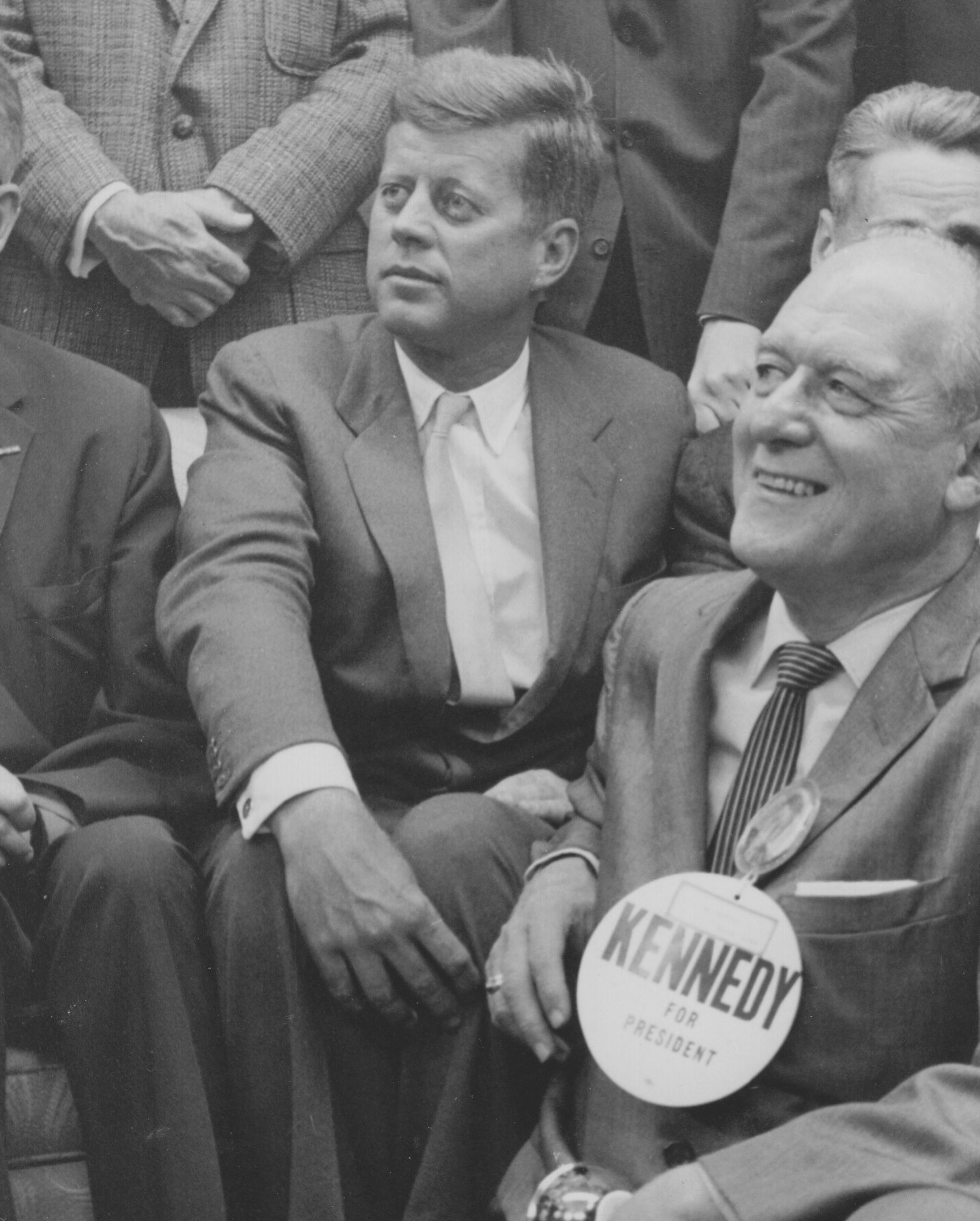
I also have a family connection to the book. Both my parents were political activists who volunteered for the Kennedy campaign.

My father attended the 1960 convention that is the highlight of the book’s opening chapters, and took the photos you see here. As a child, I got to accompany my mother to the Kennedy campaign headquarters in Chicago, where I was allowed to stamp the return address on stacks of envelopes.

Not so fast

If you’ve read any of my previous blog posts, you might be thinking, “Well, at least she isn’t talking about her new novel.”

Not so fast.

One element of LBJ’s legacy is, of course, his disastrous leadership of the war in Vietnam. And that war – specifically its lifelong impact on one woman who served – is the focus of my novel, Her Own Vietnam.

See how neatly I have twisted Caro’s award-winning masterpiece so it’s all about me?

You may well wonder what I know about the Vietnam War and its afterlife. More on that later.

Meanwhile, enjoy these photos of the past.

1960 Democratic Convention in Los Angeles. Photo by Julian P. Kanter.

1960 Democratic Convention in Los Angeles. Photo by Julian P. Kanter.


Candidate JFK at 1960 Democratic convention. Notice how big the campaign buttons are and how small the chairs. Photo by Julian P. Kanter.

Candidate JFK at 1960 Democratic convention. Notice how big the campaign buttons are and how small the chairs.
Photo by Julian P. Kanter.