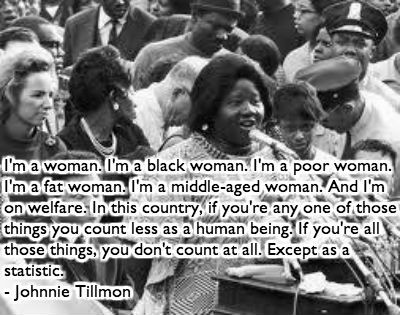
Welfare is a Women’s Issue (1972) by Johnnie Tillmon

Not every writer wants her words to be timeless. I’m sure when Johnnie Tillmon wrote this in 1972, she hoped her words and her situation would soon be obsolete. They are as true today as they were 42 years ago. Outrageous. [Reposted from Poor as Folk blog.]

Chewbecca's avatarPoor as Folk

via OUR TIME

Welfare is a Women’s Issue (1972) by Johnnie Tillmon

I’m a woman. I’m a black woman. I’m a poor woman. I’m a fat woman. I’m a middle-aged woman. And I’m on welfare.

In this country, if you’re any one of those things you count less as a human being. If you’re all those things, you don’t count at all. Except as a statistic.

I am 45 years old. I have raised six children. There are millions of statistics like me. Some on welfare. Some not. And some, really poor, who don’t even know they’re entitled to welfare. Not all of them are black. Not at all. In fact, the majority-about two-thirds-of all the poor families in the country are white.

Welfare’s like a traffic accident. It can happen to anybody, but especially it happens to women.

And that’s why welfare is a women’s issue. For a lot…

View original post 719 more words

Let the judging begin

HOV ARC

My ARCs have arrived – the Advanced Reader Copies of my novel. These are real live books that look almost exactly like the final book, except that the text has not yet been proofread and the back cover contains some technical information that won’t be in the final version.

I am not being immodest when I say the book is beautiful. I had nothing to do with its appearance – all praise goes to the designer.

Now what?

The book will be released on November 1. In the meantime, we try to get it reviewed.

My publisher is assiduously contacting book reviewers and review outlets with the hope that they will request an ARC. Many have done so and more, we hope, are pending. 

So many  books, so little time

Of course, requesting an ARC does not mean the person will actually review Her Own Vietnam, much less review it positively. Most book reviewers are writers themselves, many with outside jobs as editors or teachers. They live among teetering stacks of books and articles demanding to be read, beset on all sides by deadlines.

Like all writers, book reviewers live in the condition the novelist Alice McDermott described as “having homework every day for the rest of your life.” And like all devout readers, book reviewers have much more desire than time to read.

But still: a reviewer could be reading my novel right this second with the specific intent of judging it, in print and in public.

Different ways to hear it

Listen to this sentence in your head. You could hear it in at least two ways:

“A reviewer could be reading my novel right now!” [Delight]

“A reviewer could be reading my novel right now!” [Terror]

You be the judge.

On Father’s Day

My parents, circa 1949

My parents, circa 1949

On this Father’s Day, thought I’d share this essay I wrote about my parents for the wonderful literary journal Referential Magazine. (My essay came out in December 2013; hope you’ll explore the current edition of the magazine too.)

People rightfully decry the commercialization of Mother’s Day and Father’s Day. But the holidays do give us an opportunity to stop and reflect on our parents and, for those of us whose parents have passed on, the topic of my essay: “What Did I Have.”

http://referentialmagazine.org/lynn-kanter/


The first line – Revealed!

Three sharp red pencils.

Let’s begin.
(Photo by Horia Varlan.)

Last week I invited folks to identify ten novels written by women, based only on the first line of the novel. Many people identified several of the novels, but no one knew them all. (Neither would I.)

Here are the answers

1. “Ships at a distance have every man’s wish onboard.”

Their Eyes were Watching God by Zora Neale Hurston

2. “They shoot the white girl first.”

Paradise by Toni Morrison

3. “It began the usual way, in the bathroom of the Lassimo Hotel.”

A Visit from the Goon Squad by Jennifer Egan

4. “That night when he came to claim her, he stood on the short lawn before her house, his knees bent, his fists driven into his thighs, and bellowed her name with such passion that even the friends who surrounded him, who had come to support him, to drag her from the house, to murder her family if they had to, let the chains the carried go limp in their hands.”

That Night by Alice McDermott

5. “Dear God, I am fourteen years old.”

The Color Purple by Alice Walker

6. “Princeton, in the summer, smelled of nothing, and although Ifemelu liked the tranquil greenness of the many trees, the clean streets and stately homes, the delicately overpriced shops, and the quiet, abiding air of earned grace, it was this, the lack of a smell, that most appealed to her, perhaps because the other American cities she knew well had all smelled distinctly.”

Americanah by Chimamanda Ngozi Adichie

7. “’Yes, of course, if it’s fine tomorrow,’ said Mrs. Ramsay.”

To the Lighthouse by Virginia Woolf

8. “I told you last night that I might be gone sometime, and you said, Where, and I said, To be with the Good Lord, and you said, Why, and I said, Because I’m old, and you said, I don’t think you’re old.”

Gilead by Marilynne Robinson

9. “We slept in what had once been the gymnasium.”

The Handmaid’s Tale by Margaret Atwood

10. “It is a truth universally acknowledged, that a single man in possession of a good fortune, must be in want of a wife.”

Pride and Prejudice by Jane Austen

And the winner is…

Jan Elman Stout identified the most books: six of the ten titles (numbers 2, 3, 5, 6, 7, and 8). She will be the proud owner of Egg Heaven, a collection of powerful and haunting short stories by the award-winning writer Robin Parks.

The book will be published October 1. You can preview it here. Congratulations, Jan!


The first line

Photo: jason-denys

Photo: jason-denys

They say the first line of a novel is supposed to tell you all you need to know about the book and the reading experience ahead of you. (Is that true? Beats me. You know how they are always going around saying things.)

But it did make me think. And what I thought was: Let’s have a contest!

 A contest!

I’ll list the first line of ten novels I loved. Let’s see how many of the novels you can identify based only on the first line. Of course, you could simply google the lines and figure out all ten, but where’s the fun in that?

There’s a prize

The first person who correctly identifies the most titles will win a copy of Egg Heaven, a collection of gorgeous short stories by the award-winning writer Robin Parks. It’s the first book that will be published by Shade Mountain Press, which a month later will publish my novel. Egg Heaven will be available in October; you can preview it here.

The first lines

1. “Ships at a distance have every man’s wish onboard.”

2. “They shoot the white girl first.”

3. “It began the usual way, in the bathroom of the Lassimo Hotel.”

4. “That night when he came to claim her, he stood on the short lawn before her house, his knees bent, his fists driven into his thighs, and bellowed her name with such passion that even the friends who surrounded him, who had come to support him, to drag her from the house, to murder her family if they had to, let the chains the carried go limp in their hands.”

5. “Dear God, I am fourteen years old.”

6. “Princeton, in the summer, smelled of nothing, and although Ifemelu liked the tranquil greenness of the many trees, the clean streets and stately homes, the delicately overpriced shops, and the quiet, abiding air of earned grace, it was this, the lack of a smell, that most appealed to her, perhaps because the other American cities she knew well had all smelled distinctly.”

7. “’Yes, of course, if it’s fine tomorrow,’ said Mrs. Ramsay.”

8. “I told you last night that I might be gone sometime, and you said, Where, and I said, To be with the Good Lord, and you said, Why, and I said, Because I’m old, and you said, I don’t think you’re old.”

9. “We slept in what had once been the gymnasium.”

10. “It is a truth universally acknowledged, that a single man in possession of a good fortune, must be in want of a wife.”

Here’s a hint

These are all women writers.

The deadline is Sunday, June 8. Ready? Guess.