Why Vietnam?

Fatigue shirt

Whenever I mention my novel (which, you may have noticed, is fairly often), people ask me why I chose to write about a woman who served as an Army nurse in Vietnam. Did I serve in the war? Was I ever in the military? Am I even a nurse?

No, no and no.

But like most members of the Baby Boomer generation, my youth was shaped by the war in Vietnam – and by the movement to end it. One reason was the draft. Unlike today’s wars, which seem to be fought only by a small and grievously burdened community, the Vietnam war had the power to reach into almost any American home that had a teenage son.

The shadow of the Good War

My father and all my friends’ fathers had served in World War Two. We grew up in the glowing shadow of that Good War. But the Vietnam war was the first to be waged on television, and it became frighteningly clear that this was not a good war – and that our political leaders were lying to us about it.

The 1970 killing of American college students by uniformed troops – as the students peacefully protested on their own college campuses at Kent State and Jackson State – made me feel profoundly alienated from my own government. While it would be other issues that galvanized me, my life as an activist began that day.

Who could ever understand?

So what happened in 2000 that first gave me the idea to write a novel that would become Her Own Vietnam? Honestly, I can’t tell you.

I was walking down the street when it struck me: What would it be like to be a regular middle-aged woman, just living your humdrum life, but to have that experience in your past? To have participated in a war so hated by much of your nation that the hostility unforgivably slopped over onto you and your comrades, the very people your country sent to wage the war?

How would you feel? Who would you tell? Who could ever understand what you’d been through?

Starting from scratch

I had to start from scratch. I knew nothing about their lives. I started by reading everything I could find about women who served in Vietnam. There wasn’t that much.

Then I joined a listerv for women Vietnam veterans. They knew I wasn’t one of them, that I was there to research a novel, that in fact I had marched against the war.

Yet they welcomed me. They answered my questions and shared their stories – even some that must have been painful to tell.

“I don’t speak about Vietnam”

As I listened, I realized I had been wrong. I did know something about their lives after all.

Because many of these women, these war veterans, had for decades kept their service a secret. They were in the closet. And having come out myself in the pre-rainbow days of the early 1970s, that was an experience I understood all too well.

“I don’t speak about Vietnam, and most people in my world don’t even know I’m a veteran,” one woman told me. “I prefer it that way.”

Her name was Chris Banigan. She had been a Captain in the U.S. Army Nurse Corps, and had served two tours in Vietnam, from 1969 to 1971, based in Quang Tri and then Chu Lai.

Chris generously shared her vast knowledge and experience, from specifics about how nurses learned to deal with gunshot wounds (they treated a live, anaesthetized goat who had been shot for that purpose), to the details of her recurring nightmares about the war.

The ghosts of yesterday

She was patient with my many questions, and told me, “I actually find them quite therapeutic because it makes me think about things I’ve chosen not to think about. I think it will help me to get past the ghosts of yesterday and burst into tomorrow with a greater exuberance for life.”

Chris was the first veteran to read an early draft of my novel, and gave me her careful corrections and quiet encouragement. Because she lived in California and I lived in DC, our conversations took place via email. That changed on Veterans Day of 2003, when I was thrilled to meet her in Washington at the Vietnam women’s memorial.

A miraculous encounter

Miraculously, that day she had encountered at the Vietnam Wall a soldier who had been her last patient in Vietnam. He had been visiting the Wall for years on Veterans Day, walking along its gleaming black expanse and asking everyone if they knew a nurse named Banigan. Finally, he asked her.

She told me later, “I remember when I took him to x-ray. He was terrified that his eye had been blown out, and he could not be reassured until he saw the reflection of his left eye in the x-ray machine. Odd, the things you remember.”

Chris seemed to remember everything. “Over the last three decades, I have never gotten over the sights and smells of Vietnam and the causalities of that conflict,” she said, “and I continue to monitor the death toll in the shape of Agent Orange, PTSD and shattered lives.”

Chris Banigan died suddenly, 10 years ago this weekend, on March 15, 2004. She was only in her fifties. I am quite certain a part of her died in Vietnam.

Why Vietnam?

By telling the story of Her Own Vietnam, I hope to shine a light on a fascinating but hidden corner of our shared American history, and to honor women like Chris Banigan.

“They did not pick their war,” Chris said of her sister Vietnam veterans. “They only served.”

Click here to see Chris Banigan’s photos and descriptions of her time in Vietnam.

MY BEAUTIFUL NEW BOOK COVER!!!! and other news

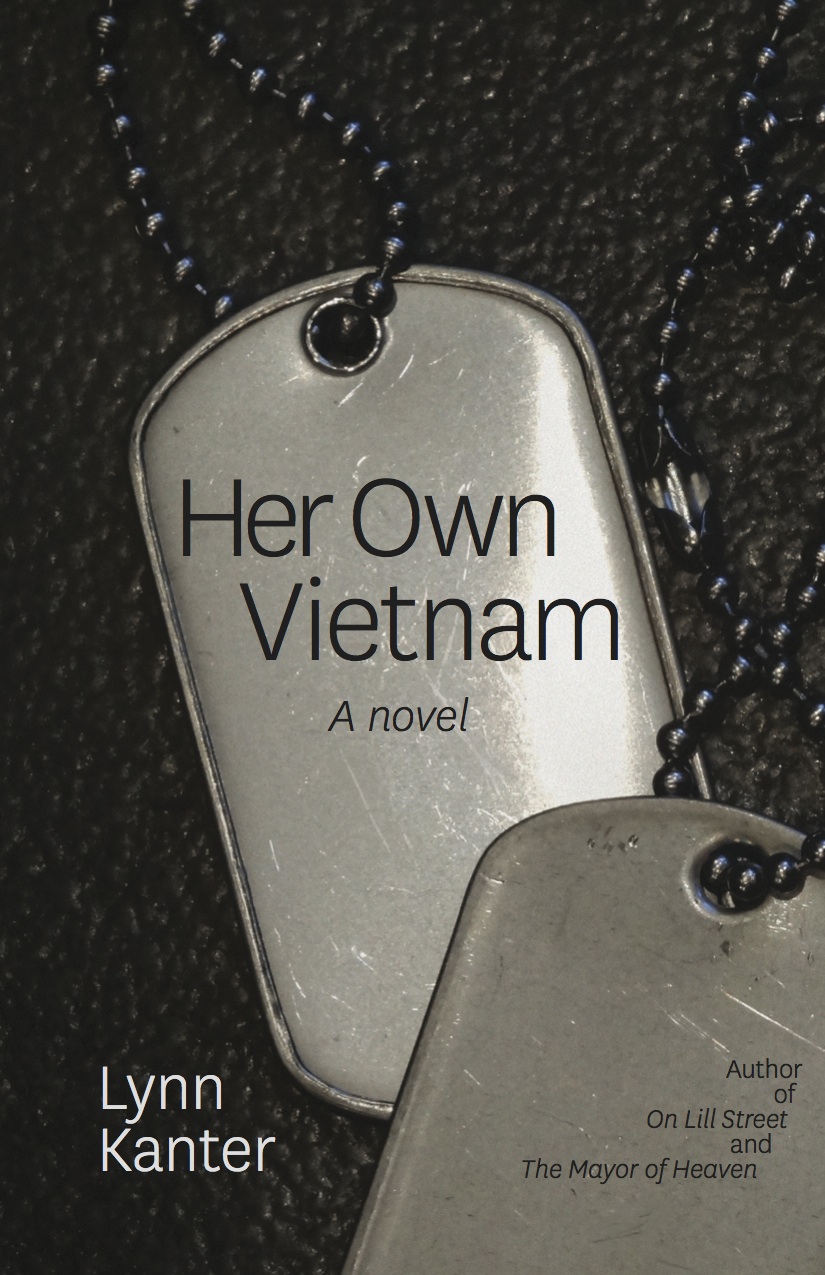
HOV CoverAllow me to introduce you to the cover of my new novel. I love it!

The cover seems to evoke the feeling of the novel. To me, this is nothing short of miraculous. An artist read my stack of words and turned them into a simple, somber, striking image.

Many publishers don’t let authors have any say over the design of their book covers. I suspect this is why so many novels by women end up with covers that all but scream, “Don’t take me seriously!”

I hated the cover of my first novel, and when I told my otherwise very kind and generous publisher, she replied, “Thank you for your input.” The cover stayed.

If you can’t take the heat

This time around, I got to collaborate with the publisher and the designer to figure out what we wanted the cover to communicate. And by collaborate, I mean something akin to me telling an expert chef, “I’d like you to make a dish that has some peas and maybe a little salt” – and then feeling very accomplished when she produces a risotto.

It’s not exactly accurate to say that I had nothing to do with the cover. I bought the dog tags, and my partner Janet took the photo. And the textured surface you see in the background? That’s our kitchen floor.

But handing a chef some peas and a pot does not a risotto make. So hats off to the designer, and let’s move on from the kitchen metaphors.

Pre-pub challenges

My publisher has asked me to write “a short description that really gets at the heart of your book.” The trick is, I have to write it in various lengths: one sentence, 50 words, 100 words, 250 words, etc. This is very difficult to do. If you don’t believe me, try to describe one of your children in 50 words.

Rosalie will take my descriptions and rework them into compelling language to interest booksellers and librarians. She has also asked me to come up with a series of key words about my novel to use in search engines and library or distributor catalogs.

Some catalogs provide a drop-down menu with oddly limited choices. You can categorize your book as a war novel, for example, but not an anti-war novel. I fear readers who are in the mood for a big, macho war novel will be dismayed by Her Own Vietnam.

Break it to me gently

In other news, one of the writers we asked to write a blurb for my book has said no. But it was a very cordial no. She let us down easy.

Meanwhile, two more blurb requests are pending. Who wouldn’t want to blurb a book with such a gorgeous cover?


Reading Women Continued: H – Z

Read Women 2014 by Joanna Walsh

Read Women 2014 by Joanna Walsh

Continuing on the theme of reading women authors in 2014 – a mini-movement launched by the writer and illustrator Joanna Walsh – here are more selections my book group has read over the years. We read books by and about women.

Again, these books represent our collective decisions, not necessarily my personal recommendations. I’ve loved many, but not all, of them.

In a previous post, I listed authors from A – G. Scroll down to find it.

Here are authors from H – Z.

  • Haigh, Jennifer – Mrs. Kimble
  • Hamilton, Gabrielle – Blood, Bones & Butter
  • Hamilton, Jane – A Map of the World
  • Hamilton, Masha – The Camel Bookmobile
  • Harris, Joanne – Chocolat
  • Hazzard, Shirley – The Great Fire
  • Hegi, Ursula – Stones from the River
  • Heilbrun, Carol – Writing a Woman’s Life
  • Hulme, Keri – The Bone People
  • Hurston, Zora Neale – Their Eyes were Watching God
  • Huston, Nancy – Fault Lines
  • Jones, Ann – Looking for Lovedu
  • Karr, Mary – Lit
  • Kearns, Rosalie Morales – Virgins and Tricksters
  • Kerman, Piper – Orange is the New Black
  • Kingsley, Mary – Travels in West Africa
  • Kingsolver, Barbara – Flight Behavior; The Lacuna; The Poisonwood Bible; Pigs in Heaven
  • Kornblut, Ann – Notes from the Cracked Ceiling
  • Lahiri, Jhumpa – Unaccustomed Earth; The Interpreter of Maladies
  • Larson, Nella – Passing
  • LeGuin, Ursula – Left Hand of Darkness
  • Lessing, Doris – African Laughter
  • Levy, Andrea – Small Island
  • Lively, Penelope – Moon Tiger
  • Livesey, Margot – Eva Moves the Furniture
  • MacDonald, Ann Marie – Fall on Your Knees
  • Maloy, Maile – Both Ways is the Only Way I Want It
  • Markham, Beryl – West with the Wind
  • Marmon, Leslie Silk – Ceremony
  • Marshall, Brenda – Dakota, or What’s a Heaven For
  • Mason, Bobbie Ann – Feather Crowns
  • McDermott, Alice – After This; Charming Billy;
  • Messud, Claire – When the World was Steady
  • Min, Anchee – Red Azalea
  • Miner, Valerie – Trespass
  • Morrison, Toni – Paradise
  • Mujica, Barbara – Frida
  • Munro, Alice – Runaway; Too Much Happiness
  • Naslund, Sena Jeter – Ahab’s Wife
  • Naylor, Gloria – Mama Day
  • Nemirovsky, Irene – Suite Francaise
  • Nunez, Sigrid – The Last of Her Kind
  • O’Brien, Edna – Country Girl; The Country Girls Trilogy
  • O’Connor, Flannery – Three by Flannery O’Connor
  • O’Faolain, Naula – Are You Somebody?
  • Orleans, Susan – The Orchid Thief
  • Otsuka, Julie – The Buddha in the Attic
  • Ozeki, Ruth – My Year of Meats
  • Patchett, Ann – Bel Canto; State of Wonder; Truth and Beauty
  • Piercy, Marge – Sex Wars
  • Prager, Emily – Eve’s Tatoo
  • Prose, Francine – Reading like a Writer
  • Proulx, Annie – Postcards; Shipping News
  • Quinlen, Anna – One True Thing
  • Reichl, Ruth – Tender at the Bone
  • Robinson, Marilynne – Gilead
  • Roffey, Monique – White Woman on a Green Bicycle
  • Roy, Arundhati – The God of Small Things
  • Sebold, Alice – The Lovely Bones
  • See, Lisa – Snowflower and the Secret Fan
  • Senna, Danzy – Caucasia
  • Shields, Carole – Unless; The Stone Diaries
  • Sittenfeld, Curtis – American Wife
  • Skloot, Rebecca – The Immortal Life of Henrietta Lacks
  • Smiley, Jane – A Thousand Acres; Duplicate Keys
  • Smith, Abbe – The Case of a Lifetime
  • Smith, Patti – Just Kids
  • Smith, Zadie – White Teeth
  • Soulif, Ahdaf – The Map of Love
  • Stockett, Kathryn – The Help
  • Strayed, Cheryl – Wild
  • Strout, Elizabeth – Amy and Isabelle; Olive Kitteridge
  • Summer, Jane – The Silk Road
  • Trapido, Barbara – The Traveling Hornplayer
  • Tremain, Rose – Sacred Country
  • Walls, Jeanette – Half Broke Horses
  • Waters, Sarah – Fingersmith; The Night Watch; Tipping the Velvet
  • Weber, Katharine – Triangle
  • West, Dorothy – The Wedding
  • Wharton, Edith – The House of Mirth
  • Wilentz, Amy – The Martyr’s Crossing
  • Wilkerson, Isabelle – The Warmth of Other Suns
  • Williams, Lena – It’s the Little Things
  • Winterson, Jeanette – Art and Lies; Why be Happy when you can be Normal; Written on the Body
  • Woolf, Virginia – A Room of One’s Own; Mrs. Dalloway
  • Zeller, Zoe – The Believers; Notes from a Scandal

Roots of the War on Poverty

Lyndon Johnson speaks at 1960 Democratic Convention. Photo by Julian P. Kanter.

Lyndon Johnson speaks at 1960 Democratic Convention. Photo by Julian P. Kanter.

I’m reading The Passage of Power, the fourth book of Robert Caro’s multi-volume biography of Lyndon Johnson. The book recreates in vivid detail the years 1958 through 1964, during which Johnson wielded enormous power in the Senate, reached for the Presidency with a baffling strategy guaranteed to fail, became Vice President, and gained the Presidency in a way he never expected.

Oh, and he launched the War on Poverty and the most transformative civil rights policies since emancipation.

 The story speaks to me personally

The story speaks to me personally on so many levels.

Johnson’s youth was twisted by poverty. As President, he marshaled the might of the federal government to improve poor people’s lives in a way that was bold at the time and almost inconceivable in the heartless policy environment of recent decades.

How to shift the way people imagine the possible – so that it is the persistence of poverty in America that becomes inconceivable, rather than the hope of ending it – is the driving passion of the Center for Community Change, where I’ve worked for more than 20 years. So it’s fascinating to learn how Johnson found ways to advance so dramatically both civil rights and anti-poverty efforts.

A family connection

I also have a family connection to the book. Both my parents were political activists who volunteered for the Kennedy campaign.

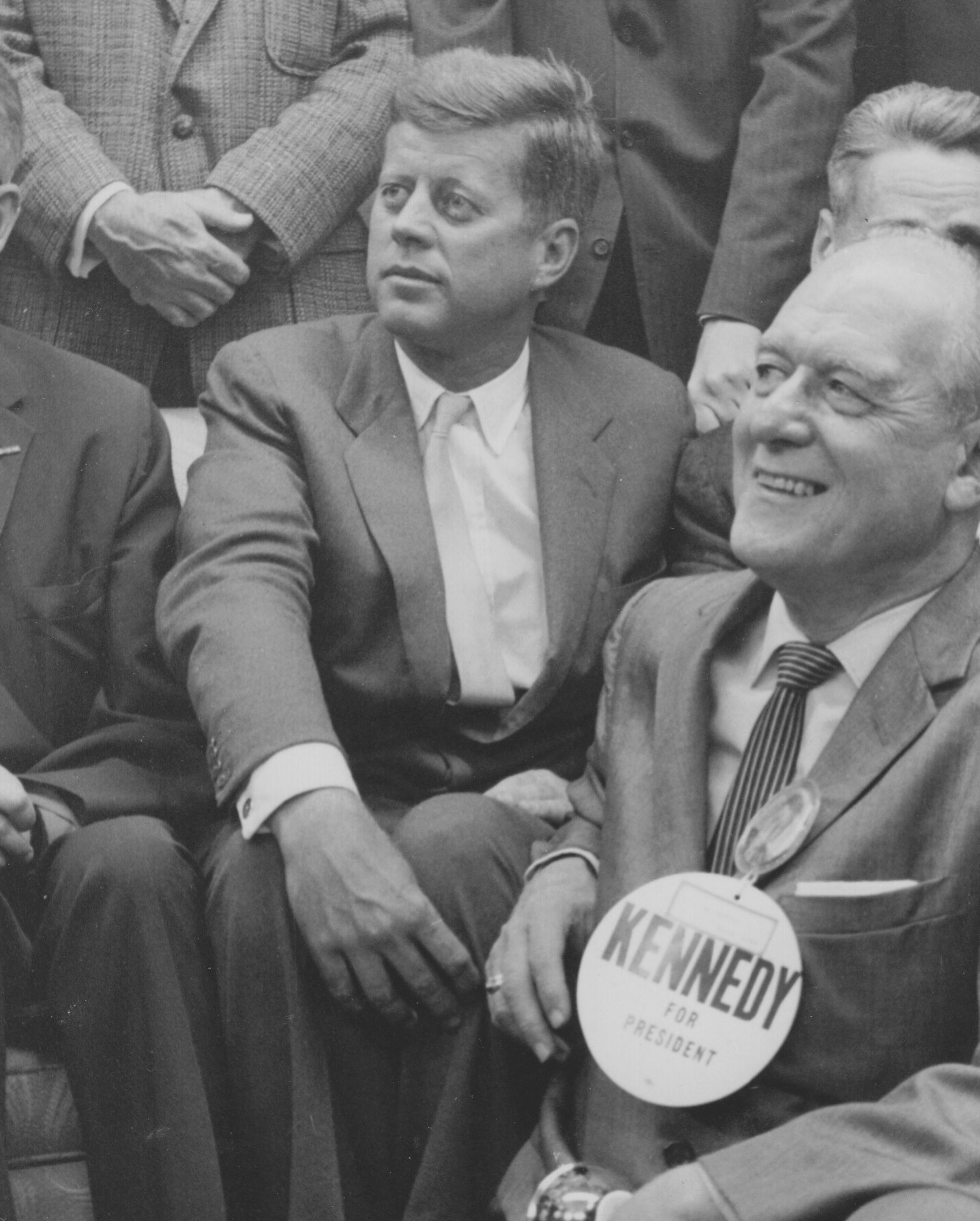
My father attended the 1960 convention that is the highlight of the book’s opening chapters, and took the photos you see here. As a child, I got to accompany my mother to the Kennedy campaign headquarters in Chicago, where I was allowed to stamp the return address on stacks of envelopes.

Not so fast

If you’ve read any of my previous blog posts, you might be thinking, “Well, at least she isn’t talking about her new novel.”

Not so fast.

One element of LBJ’s legacy is, of course, his disastrous leadership of the war in Vietnam. And that war – specifically its lifelong impact on one woman who served – is the focus of my novel, Her Own Vietnam.

See how neatly I have twisted Caro’s award-winning masterpiece so it’s all about me?

You may well wonder what I know about the Vietnam War and its afterlife. More on that later.

Meanwhile, enjoy these photos of the past.

1960 Democratic Convention in Los Angeles. Photo by Julian P. Kanter.

1960 Democratic Convention in Los Angeles. Photo by Julian P. Kanter.


Candidate JFK at 1960 Democratic convention. Notice how big the campaign buttons are and how small the chairs. Photo by Julian P. Kanter.

Candidate JFK at 1960 Democratic convention. Notice how big the campaign buttons are and how small the chairs.
Photo by Julian P. Kanter.

Where Are the Women?

My novel will be published by Shade Mountain Press, a new feminist press dedicated to publishing literary fiction by women. Wait – it’s 2014. Do we still need feminist presses?

Alas, yes.

Although women buy more books than men (58% of books purchased in 2012, according to the latest research), women writers are published and reviewed at much lower rates than men. In 2012, the percentage of women authors published barely reached 30% at most  publishing houses, from the big commercial houses like Knopf (23%) to the smaller, literary publishers like Graywolf (25%). 

As for reviews, in 2012 The New Yorker published 583 reviews of books written by men, and only 218 books by women authors. The record is equally dismal at most other major review outlets. (These publishing stats, and many more, can be found at Vida.)

Good News, Bad News

Good news: In 2012, 63% of the best-selling books in the U.S. were written by women. Bad news: Women writers received only 40% of the industry’s earnings. (Read more here.)

Math was never my strong suit, but even I can see there’s something wrong with those numbers. That’s why I’m excited to be part of a bold new publishing venture that will raise women’s voices.

What Do You Think?

Do the statistics about the disparity of women in print surprise you? Or do they confirm what you already knew or suspected?

Photo by Kate Ter Haar

Photo by Kate Ter Haar