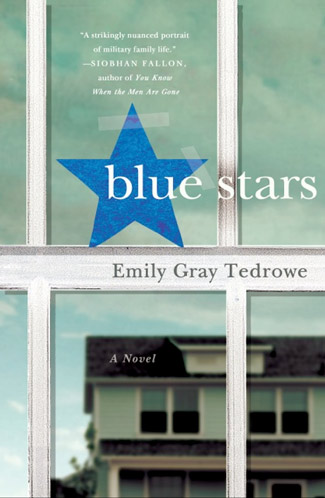
30 Women Novelists You Should Know – #24 Emily Gray Tedrowe

Emily Gray Tedrowe

Like everyone of my generation, I’ve lived through several periods when the U.S. was at war. Then came a time, continuing to this day, when the U.S. was perpetually at war. Politicians launch these conflicts, and soldiers fight them. But when soldiers are injured, it is their families – mostly mothers and wives – who live ever after with the legacy of those wars.

Blue Stars by Emily Gray Tedrowe is the story of two such women, and it takes you deep into the world of tedium and terror that was Walter Reed Military Hospital in Washington, DC during 2005.

Two women who couldn’t be more different

Ellen Silverman is a literature professor, an opponent of the wars in Iraq and Afghanistan who holds George W. Bush and his entire Cabinet in contempt. She is the mother of a college-age son and daughter and the guardian – for all intents and purposes, the mom – of Mike, a young man who went to high school with her son. She is aghast when Mike tells her he enlisted in the Marines, but that’s nothing compared to her horror when he returns from Iraq grievously wounded – one of many thousands of young amputees.

Lacey Diaz couldn’t be more different from Ellen. She is the mother of a young son and married to an officer in the Reserves, a man who is easier to love when he’s on deployment far away. Lacey lives in “Mil-world,” surrounded by other military families. She’s a leader in this community and is convinced, as they are, that any question of the war effort is tantamount to treason. An accident in Iraq leaves her serious, upright husband blind and childlike from a traumatic brain injury whose impact may or may not be permanent.

Close friends and lifelines

Take these two women out of their daily lives, throw them together in the high-stress fishbowl of a medical military village where everything is at stake but nothing makes sense, and you have one hell of a novel.

Family members don’t just visit patients at Walter Reed; they live there, week after week, month after month, helping their soldiers navigate the convoluted systems, advocating for them amidst the dense military regulations and jargon, trying to help the patients and each other adjust to a life of being broken. Ellen, usually so competent and in control, is lost in this world. Lacey conquers it. These two women – whose respective age and class would normally ensure that they never meet – become close friends and lifelines for one another.

Real-world characters with real-world problems

Blue Stars is my favorite kind of novel: a gripping human drama that deals head-on with vital questions of gender, race and class, war and peace, resistance and allegiance. Tedrowe has created complicated, lively characters and placed them in a real-world location with real-world problems. I still miss brash, brave Lacey Diaz, who engages in one of the most satisfying blow-ups in literature.

Blue Stars is Tedrowe’s second novel. Her first book, Commuters, came out in 2010. You can bet I’ll be standing in line for her third.

Get a FREE copy of Blue Stars

I’m giving away a free copy of Blue Stars through my newsletter in April. For a chance to win it, sign up for my newsletter.

cover_blue-stars

30 Women Novelists You Should Know – #23 Shelley Ettinger


Shelley Ettinger

Vera’s Will by Shelley Ettinger is a powerful family saga that spans continents and generations. You’ve probably read many novels that could be described that way. I’ll bet you’ve never read anything like Vera’s Will.

The book begins in Czarist Russia in 1903, where the Resnikoff family – Jewish and leftist – Is brutally attacked during a pogrom. We see the rampage mostly through the eyes of five-year-old Vitka, who understands less than we do about what the hate-crazed men – some of them neighbors and co-workers – are doing to her mother and father.

An outsider in so many ways

Ten years later, Vitka Resnikoff has become Vera Resnick, a modern American girl living in New Jersey, embarrassed by her parents’ immigrant ways. Vera is already an outsider: no longer Russian, not quite American. As if that’s not enough, she falls in love with another girl – the only two women in the world, they feel sure, to be so blessed and so cursed.

Years later, after her lover dies of influenza, Vera in her grief marries a punctilious man who moves her from working class Passaic, where everyone in her family is a leftist activist, to bourgeois Manhattan, where he speaks of nothing but his business. After years of loneliness, Vera falls for another woman. Vera’s husband, backed up by all the scientific experts of the day, declares that Vera is too sick to be allowed to raise their two sons.

Intertwined but alone

He takes the children away but Vera eventually finds them and follows them to suburban Detroit, where her sons grow into resentful adults. Vera nurses one of them through his WWII war injuries. He marries and has a daughter named, unwittingly, after Vera’s first, lost love. That daughter also grows up to be a lesbian, and the second storyline in the novel is hers.

Ettinger does a wonderful job of creating two crisp, lively narrators, each voice sharply distinct and suffused with character.The intertwined story of these two women, grandmother and granddaughter, who share so much but know so little about one another’s lives, create a moving and satisfying whole.

“Gals like you aren’t rare.”

They are engaged in their own struggles but also in the restless world around them. Through their eyes and their activism we see wars, McCarthyism, labor action, the civil rights movement, the rise of the women’s and lesbian/gay rights movements – a history of social change in America. When the granddaughter comes out to her brother in the 1970s, he musters the same tired scientific arguments that Vera’s husband once used. And yet, as Vera’s sister-in-law tells her in the 1940s, “Gals like you aren’t that rare. Did you think you were the only one who parts her hair on the other side?”

A surprising pleasure

Lately I’ve been reading some of the bright, brittle novels written by talented authors in their twenties and thirties. Most of these books I’ve enjoyed, and a few I’ve admired. But what a pleasure it is to read a book written by a novelist who brings a sense of history and her own lived wisdom to the task. Here’s an example:

This is more than grief, Vera knows. This is rage… This kind of fury. This kind of pain. When wrongs are done to you and yours. There is a righteous wrath that picks you up and sweeps you away. Sweeps you clean. And the anger is good, and the anger is true – but it takes you to a far country where no one can live all the time.

The world of Vera’s Will is a far but familiar country. I was sorry to leave it.

Get a FREE copy of Vera’s Will 

I’m giving away a free copy of Vera’s Will through my newsletter in April. For a chance to win it, sign up for my newsletter.

Vera's Will COVER jpeg

Art and outrage

The Triangle Shirtwaist Factory fire took place 104 years ago this week. It inspired grief, outrage, the birth of a union, a host of labor laws and many books, including a brilliant novel called Triangle, by Katharine Weber.

I wrote about the novel a year ago, and thought I’d share the blog post with you again during this anniversary week.

From the archives

Triangle weaves together the stories of Esther Gottesfeld, the last living survivor of the Triangle Shirtwaist factory fire of 1911; her scientist granddaughter; and a feminist researcher who asks Esther to share her memories and then listens a bit too carefully. The novel is riveting and challenging, with complex characters.

Who owns history?

Weber deftly builds both the mystery at the heart of the novel and the tense drama of the Triangle inferno. Small details that at first seem to provide only texture to the story later loom with horrifying impact.

The ending of the novel sent me racing back to the beginning with a new understanding – or at least new questions – about the plot. Triangle does not yield its insights easily, which makes it the best kind of book group selection, ripe for animated discussion.

Who owns history? The person whose story you believe.

 A tragedy and a legacy

The Triangle Shirtwaist fire was a predictable and preventable tragedy that killed 146 workers – mostly young immigrant women – at a clothing factory in New York.

Triangle fire w bodies

Dozens of the workers leaped to their deaths from the top floors of the blazing building, an image that anyone who lived through 9/11 can conjure all too easily. Even more people burned to death, many of them trapped behind locked doors in flaming workrooms. Others crawled onto rickety fire escapes that collapsed and sent them plunging to the sidewalk.

More than 350,000 people marched in the streets of New York to mourn the garment workers. Outraged by their needless and excruciating deaths, factory workers organized and won many of the workplace safety laws we take for granted today.

A story less known

A year before the Triangle Shirtwaist fire, some 20,000 women who worked in garment factories had gone on strike to demand better wages, a shorter workweek (52 hours), and specific safety measures. These working class women, many of them Yiddish-speaking immigrants, drew the support of New York’s suffragists, some of whom were women from the city’s wealthiest families.

Photo: hbo.com

Photo: hbo.com

The suffragists raised funds for the workers, bailed them out of jail, and organized mass rallies to generate public solidarity. Across the city, factories conceded to the workers’ demands, acknowledged the unions, and improved workplace safety.

Photo:: UNCPressblog

Photo:: UNCPressblog

But not the Triangle Shirtwaist factory. The two owners – Max Blanck and Isaac Harris – refused to unionize and refused to address safety concerns, including workers’ calls to leave factory doors unlocked and provide functional fire escapes.

A year later, these safety issues cost 146 people their lives. Yet they cost the factory owners nothing – in fact, the two men profited from the tragedy. While they settled lawsuits by paying family members $75 for each lost life, the owners received insurance settlements of $400 for each worker killed. The two men went on to run other factories, accumulating and ignoring citations for the very safety violations that had led to the carnage at the Triangle Shirtwaist factory.

Haunted

The lessons of the Triangle Shirtwaist Factory fire – both learned and unlearned – continue to haunt us today. A powerful novel like Triangle takes you into that world, and part of you is likely to remain there for a long, long time.

Triangle book cover

Update from Book World

Her Own Vietnam has been out in the world for four months now. Let me share a little about what that feels like for the author.

Publishing a novel is like releasing a long, silvery fish into a swift-moving river. You know your fish is out there, you catch a glimpse of it now and then, but you can never be sure exactly where it is or what is happening in its dim watery world.

Book reviews

One glimpse I get of my novel is through book reviews. Her Own Vietnam has gotten some great reviews, most recently a five-star review in the Spring 2015 edition of the magazine Foreword Reviews. You can read excerpts from all the reviews here.

Reader reviews

For me, the most meaningful reviews are the comments I get from readers, either through email or on sites like Amazon and Goodreads. Here are a few: Paul Hellweg is a male Vietnam veteran and a writer himself, with a Vietnam website (www.VietnamWarPoetry.com). He wrote:

I’ve just finished Her Own Vietnam, and reading it has been a meaningful experience. Lynn Kanter accurately portrays the long-term effects of PTSD. In particular, I liked and appreciated the acknowledgement of how people with no experience of psychological trauma cannot comprehend how the victim suffers. Like Della Brown in the novel, I’ve encountered way too many folks who think the war is all over now and I should just forget about it… I also like the way the book portrays the loneliness of a trauma survivor living in a world where no one else understands you.

On the Goodreads website, a reader wrote:

Five stars means “Drop what you’re doing and read it. This book blew me out of the water.” Her Own Vietnam gets five stars.

Each member of the cast is vividly drawn, none is a type or stereotype, yet as an ensemble they convey the complex, bitter legacy of the Vietnam War and even offer hope that we might as a people come to terms with it if we can muster the courage to look ourselves in the eye. Her Own Vietnam is a tour de force.

And on Amazon, where all of Her Own Vietnam’s reviews have been five stars, one of my favorites said:

This is a wonderful novel. It was so enthralling, I didn’t want the book to end! The characters (love, love, love Della and Charlene) and plot lines are rich, moving and powerful. Allows all of us to ask, no matter our own experience or inexperience with matters of war, incredibly difficult questions of ourselves and our society about the ravages that violent conflict has on the human race.

A special thrill

And one more glimpse: The renowned historian David Roediger (author of The Wages of Whiteness) is teaching Her Own Vietnam in his American studies class at the University of Kansas. I love the idea of young people using my book as a tool to examine and understand the Vietnam war.

Swimming away

So, my novel is swimming out there somewhere. As I stand on the riverbank, straining to see that flash of silver, I can only hope that each reader who finds Her Own Vietnam will tell one other person, “Hey, you’ve got to read this book.” Irma HOV and coffee

30 Women Novelists You Should Know – #22 Pamela DiFrancesco

When Pamela DiFrancesco first approached me about reviewing the debut novel The Devils that have Come to Stay, I said no. I had never heard of a subgenre called Acid Western, but whatever it was, I knew it was not for me.

Wrong on all counts.

A riveting novel

The Devils that have Come to Stay is a riveting novel. You can read it to see what happens next. You can read it as a powerful indictment of the cruelties of the Gold Rush years in America or of capitalism itself. You can read it to submerge yourself in unique characters and a distinctive historical place and time.

The novel is allegorical: a nameless Narrator takes an epic journey to find his wife and his own redemption, along the way meeting up with a Native American man with strange powers whose moral mission is larger than his life, and a terrifying Stranger whose lust for gold has made him vicious and vulnerable, a perfect man of the Gold Rush. At the same time, the book is so grounded in the specifics of daily life in California during the Gold Rush – what people ate, how they dressed, how they spoke – that the hallucinatory aspects of the book are balanced by its tangible details.

So what is an Acid Western?

It started as a film genre in the 1960s, which the film critic Jonathan Rosenbaum said, “expresses a counterculture sensibility to critique and replace capitalism with alternative forms of exchange.” The word “acid” refers not to the harshness of the stories – although Devils is quite stark – but to the hallucinogens that were popular when the genre was launched.

Pamela DiFranceso explained it to me like this: “The book is literary fiction. While my novel uses the tropes of a subgenre, it offers social and political commentary, and the search of the individual for a greater consciousness that represents a struggle beyond his own. I like to think my book is a western in the same respect that Cormac McCarthy’s books are.”

Pamela had me at “literary fiction.” And their self-description didn’t hurt either: “a genderqueer person writing through a radical leftist lens.” (Pamela prefers to be referred to as the non-gender specific “they” and “their” rather than “she” and “her.”)

Q&A Interview

Here is my interview with the novelist Pamela DiFranceso.

Q. How did you first become acquainted with the subgenre Acid Western?

A. My first introduction to the Acid Western genre was through Jim Jarmusch’s Dead Man, which is generally considered the epitome of the genre (even though it came about 20 years after the most popular moment for the genre).

Q. Do you consider acid Western to be the subgenre you’ll continue to write in, or did it seem appropriate only to this novel?

A. This will probably be my only Acid Western. While I really enjoyed writing in the genre, I like challenges and so am always pushing myself to do new things. My second novel is set in a dystopian New York City in the not-so-distant future.

Q. What prompted your interest in the underside of the Gold Rush years?

As someone who’s studied alternative views of history, I knew that the Gold Rush couldn’t be the spirited, exciting time that many Americans take it to be. Between the years of 1845 and 1870, somewhere around 120,000 Native Americans in California died from violence and new diseases brought by westward expansion. As I studied the time period, I learned more about the brutality of westward expansion, from capitalist violence like the foreign miners’ taxes levied only against Chinese and Latin American miners, to tales of the beheading of Mexican men that supposedly spoke to the North American narrative of beheading Mexico in the Mexican-American war. The more I learned, the more I wanted the real story of the Gold Rush to be told.

Q. It seemed to me that the authenticity of your portrayal of life during the Gold Rush era is what enabled the more hallucinatory moments in your novel to soar. What kind of research did you do to portray the era in a realistic manner?

A. I spent so many days in the New York Public library poring over books. I read Me-wuk folk tales, books that chronicled weather patterns and foliage growth in California in the 1840s, books on the social history of the time, books on the day-to-day items used then. I copied vernacular out of diaries and hung up a list to look at while writing dialogue.

I feel like you have to do these things any time you’re building a world in a novel. You need to know how the world sounds and feels and tastes and smells, if you’re going to make that world come alive on the page. And if you’re going to push the boundaries of realism, like I did in this book, you’d better make that world all the more solid and real first.

Q. What made you decide to write a novel with three main characters, all of whom are men – and nameless?

A. Though the main characters of the novel are men, there are several characters who push the boundaries of gender in the novel – in fact, I would consider one of them to be one of the heroes of the novel. Due in part to my own gender identity and that of my partner, I was fascinated to learn that gender was often a shifting and fluid thing during the Gold Rush era. For example, very few women traveled West during the Gold Rush, and thus many ’49ers often ended up taking on traditionally female roles. There was no small amount of homoeroticism going on. What’s more, many people who were assigned female at birth took on the roles of men either in dress, socially, or both. Some certainly were trans men, but other were women who wanted to live adventurous lives and felt they couldn’t do so as women. The boundaries of identity in the Gold Rush were as shifting as the landscape itself.

Q. Anything else you’d like potential readers to know regarding your novel? Or you?

A. When I first started sending this book out to agents and publishers, I received what was probably the best rejection letter ever, stating that it was far too dark for it ever to be published. I kind think of that now, and how what one person sees as something that should never see the light of day, other people enjoy enough to put the work of a bunch of people behind. I think there’s a lesson in there about being an artist – it’s all about finding the people who think what you do works.

It’s their party

The Devils that have Come to Stay was published on February 13, 2015. At my book launch party, you could get wine. At Pamela’s launch party, you could get $13 tattoos.

Read this novel, and then look out for Pamela DiFrancesco’s next book. I have a feeling it will be something to behold.

Get a FREE copy of The Devils that have Come to Stay

I’m giving away a free copy of Pamela’s novel through my newsletter in March. For a chance to win it, simply sign up for my free newsletter, and when you receive the March edition just hit REPLY and tell me which giveaway book you want.

Devils