30 Women Novelists You Should Know – #9 Masha Hamilton

In the waning days before my novel Her Own Vietnam is released, I’m writing about 30 Women Novelists You Should Know. Today – Masha Hamilton.

I know this isn’t fair

It’s not really fair to consider a novelist’s non-writing life when you think about her literary work. For example, we all know of highly lauded male writers who are famous for being misogynistic jerks in real life. (OK, I admit I don’t read those writers for that very reason.)

But with the novelist Masha Hamilton, it’s difficult for me to separate my admiration for her books from my admiration for the way she conducts her life.

 Are you tired yet?

She spent most of her career as a journalist, reporting from Afghanistan, Kenya, Moscow and the Middle East, among other places. She served as the Director of Communications and Public Diplomacy at the U.S. Embassy in Afghanistan. Now she works for Concern Worldwide, an NGO that seeks to eliminate extreme poverty around the world. In her spare time, Masha founded two world literacy projects, the Camel Book Drive in Kenya and the Afghan Women’s Writing Project.

Oh, and she’s written five acclaimed novels.

It’s true Masha Hamilton is a friend of mine. But c’mon, who could fail to be impressed by this level of literary and humanitarian accomplishment? Just reading about it makes me tired.

Oh, right – the books

Masha’s novels are Staircase of a Thousand Steps (2001), The Distance Between Us (2004), The Camel Bookmobile (2007), 31 Hours (2009) and What Changes Everything (2013), which has a wonderful book cover.

Her books deal with the vital issues of our time through the lens of compelling human stories. To enjoy the novels, you don’t need to know anything about the concerns she addresses – the lives of women in the Middle East, the toll of war on journalists and civilians, the challenge of spreading literacy in Kenya, the dangers of cultural naiveté, the lure of radicalism, the power of parental love. You can just let yourself be gripped by the plot, the suspense, the characters, and the tactile details that make you see, hear, smell and feel the locations, whether Afghanistan or Brooklyn.

I happen to be fond of books that persuade you toward a point of view. But Masha’s novels don’t do that.

They invite you instead to look behind all the warring points of view and find compassion for the striving, suffering human beings who are simply trying to do the best they can – for themselves, their families, their nations – with their one fleeting life.
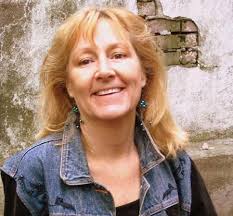
Masha Hamilton

Masha Hamilton

30 Women Novelists You Should Know – #3 Octavia Butler

You would think that writing novels might sate your appetite for reading them, but I’ve found the opposite to be true. There seem to be countless numbers of novelists out there, writing dazzling books.

As the November 1 publication date approaches for my own novel, Her Own Vietnam, I’m writing about 30 of my favorite women novelists. I dare you to read their books and not become a fan.

The majesty and mystery of Octavia Butler

First, that name. Octavia Butler. There’s majesty and mystery to it. Someone knew something when that child was born. And that makes sense, because Octavia Butler’s books are full of people who have special ways of knowing.

You could call her a science fiction writer, although I don’t actually think of her that way. I think her books ask the universal question of all fiction: “What if?”

However, she certainly swept the top literary awards for science and fantasy fiction, winning both the Nebula and Hugo awards – twice.

Octavia Butler wrote 12 novels that comprised three different series, and two additional stand-alone novels. Many of these books unfold in worlds different from our own, with characters that are not strictly human.

Creating new worlds and reshaping familiar ones

Her most famous novel, Kindred, takes place in a completely familiar world. It has one small wrinkle, though: the main character, a young African American woman, keeps being flung back in time to a plantation in rural Maryland. There she is both enslaved and entrusted with a mission to save the future, including her own.

I am not a big fan of science fiction or fantasy, but I am a fan of Octavia Butler. Her books create other universes that serve as mirrors to examine what is most human in us. How do we understand and respond to race, gender, otherness? What makes a family? What is the purpose of power? How thin is the line between what we know and what we fear?

Fearless

Octavia Butler herself seemed fearless. As an African American woman and a lesbian, she broke new ground and demanded respect in the predominantly white, male field of science fiction. She was the first writer in that genre to win a MacArthur Fellowship, which we all secretly think of as a genius grant.

She was an imposing woman, 6 feet tall, yet shy and introverted, according to her own description. I had the privilege of hearing her speak several months before her death in 2006, and she was witty and humble as she addressed an adoring, standing-room-only audience.

Octavia Butler died at 58. Who knows where else she might have taken us with her words?

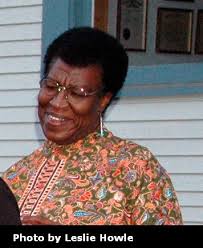
Octavia Butler (Photo by Leslie Howle)

Octavia Butler
(Photo by Leslie Howle)


Women and War

Fatigue shirt

My father served on Okinawa in World War II. That 21-year-old Army lieutenant from Chicago probably could not have imagined that 70 years later the U.S. military would still be a dominant force on Okinawa, setting the rules and occupying twenty percent of the land on that tiny, crowded island.

Above the East China Sea

Of course, you don’t need to wear a uniform to be transformed by war. Just ask the two teenaged girls at the heart of Sarah Bird’s luminous and compelling novel, Above the East China Sea.

Okinawan daughter Tamiko Kokuba has eagerly embraced the Japanese propaganda about the crudeness of her own culture and the superiority of the “true Japanese spirit.” She only learns the truth in 1945, when she and hundreds of other Okinawan girls are pressed into service in the nightmarish cave hospitals of the Japanese army.

In 2014, Luz James has just moved to Kadena Air Base on Okinawa, yet another leap in the endless hopscotch of her life as the daughter of a single mom who’s a gung-ho U.S. Air Force sergeant. But this new assignment is different, because Luz’s beloved older sister has just been killed in Afghanistan, and Luz isn’t sure she wants to keep on living.

The two girls, separated by generations and cultures, are connected in ways Luz only begins to discover as she learns how to reckon with her family’s history and the long shadow of empire.

As a reader and a writer

As a reader, I was enthralled by Above the East China Sea, and felt bereft when I finished the book and was forced to leave its fictional world. As a writer, I was deeply impressed.

An immense amount of research must have gone into the writing, yet it never seems didactic. I learned a good deal about the history and culture of Okinawa, and fascinating details about the lives of today’s “base kids,” bouncing around the world from one U.S. military post to another, perpetually unable to claim a hometown. Sarah Bird also does something interesting and unexpected with the narrative point of view toward the end of the novel.

Beyond women and war

It’s no mystery that the concept of women and war intrigues me, since I wrote a novel about a woman who served in Vietnam and the impact that experience had on her and her family. So I was surprised to discover that I had only read 10 of the 50 novels described in this excellent article by Soniah Kamal.

Kamal defines her list, quite rightly, not as women writing about war, but as women writing about “conflict, displacement and resilience.” Her list includes some books I’ve loved: The Poisonwood Bible by Barbara Kingsolver; American Woman by Susan Choi; Small Island by Andrea Levy; The Dew Breaker by Edwidge Danticat; The Good Terrorist by Doris Lessing; Bel Canto by Ann Patchett.

Given the spaciousness of Kamal’s definition, we can all probably think of other novels that might have been included. For me the best – or, depending on your point of view, worst – thing about Kamal’s article is that I now have 40 more novels to add to my to-be-read list.

Update from Book World

This book is purr-fect.

This book is just purr-fect.

Meet Viviane, the editorial assistant at Shade Mountain Press. She loves Her Own Vietnam. Let’s hope readers and reviewers demonstrate the same exquisite literary taste.

Here’s a quick update on where things stand in the publication process.

Her Own Vietnam is going to print!

I’ve made all my final changes to the book and sent them to the publisher, Rosalie Morales Kearns. She added her own corrections and sent the manuscript to the designer, who produced a final version ready for printing. After a few more tweaks to the back cover design, Rosalie will send my book to the printer.

From a writing point of view, the book is finished – out of my hands, and on to become a real, physical object that cats can walk upon.

As the printer churns out copies of the book, Rosalie and the designer will be hard at work creating the ebook version of Her Own Vietnam.

My first public reading

I’ll be reading from and discussing Her Own Vietnam at Chicago’s venerable feminist bookstore, Women and Children First, on Friday, November 14th. If you’re in Chicago, please come!

November 1 is approaching fast

My book will be published on November 1. That date, which once seemed so far in the future, is zooming toward me, and I have so much to do before then. Line up more readings. Set up author pages on Goodreads and Amazon. Find ways to get the word out to potential readers. Brace myself for reviews from journals and readers.

And mostly, get accustomed to the fact that my brainchild will soon be out in the world.

Okay, I lied

Viviane doesn’t actually work for Shade Mountain Press. It would be more accurate to say that Rosalie, the cat’s ostensible owner, works for Viviane.


Welfare is a Women’s Issue (1972) by Johnnie Tillmon

Not every writer wants her words to be timeless. I’m sure when Johnnie Tillmon wrote this in 1972, she hoped her words and her situation would soon be obsolete. They are as true today as they were 42 years ago. Outrageous. [Reposted from Poor as Folk blog.]

Chewbecca's avatarPoor as Folk

via OUR TIME

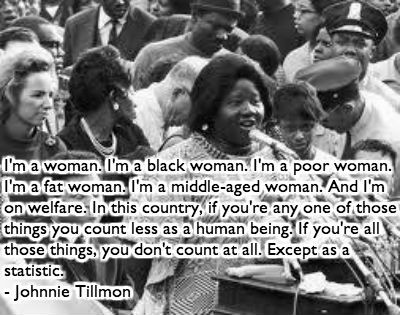
Welfare is a Women’s Issue (1972) by Johnnie Tillmon

I’m a woman. I’m a black woman. I’m a poor woman. I’m a fat woman. I’m a middle-aged woman. And I’m on welfare.

In this country, if you’re any one of those things you count less as a human being. If you’re all those things, you don’t count at all. Except as a statistic.

I am 45 years old. I have raised six children. There are millions of statistics like me. Some on welfare. Some not. And some, really poor, who don’t even know they’re entitled to welfare. Not all of them are black. Not at all. In fact, the majority-about two-thirds-of all the poor families in the country are white.

Welfare’s like a traffic accident. It can happen to anybody, but especially it happens to women.

And that’s why welfare is a women’s issue. For a lot…

View original post 719 more words