(Scary) Update from Book World!

Three sharp red pencils.

My editor gets down to business. (Photo by Horia Varlan.)

My publisher (who’s also my editor) told me she has almost finished editing my book. She will send me the edited version of Her Own Vietnam on Monday. That means she’s probably bent over my manuscript right this minute, her red pencils honed to scalpel sharpness, the sawdust scent of pencil shavings fresh in the air.

Okay, no pencils are actually involved. She’s using Track Changes.

But still – scary.

Want to know more about this formidable creature, the publisher and writer Rosalie Morales Kearns? (She IS formidable. She’s also warm and hilarious.)

Check out the Shade Mountain Press website below. There you can find info about the press and the publisher; the first official descriptions of my novel and Egg Heaven, the amazing short story collection by Robin Parks; AND a call for submissions for Shade Mountain’s 2015 books.

Are you a woman writer? A novelist who’s a woman of color? Shade Mountain Press is looking for you.

While you explore the website, I’ll just be here, waiting for my marked-up manuscript and biting my nails.

http://www.shademountainpress.com/index.php


Why Vietnam?

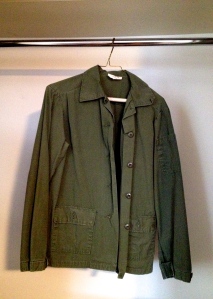
Fatigue shirt

Whenever I mention my novel (which, you may have noticed, is fairly often), people ask me why I chose to write about a woman who served as an Army nurse in Vietnam. Did I serve in the war? Was I ever in the military? Am I even a nurse?

No, no and no.

But like most members of the Baby Boomer generation, my youth was shaped by the war in Vietnam – and by the movement to end it. One reason was the draft. Unlike today’s wars, which seem to be fought only by a small and grievously burdened community, the Vietnam war had the power to reach into almost any American home that had a teenage son.

The shadow of the Good War

My father and all my friends’ fathers had served in World War Two. We grew up in the glowing shadow of that Good War. But the Vietnam war was the first to be waged on television, and it became frighteningly clear that this was not a good war – and that our political leaders were lying to us about it.

The 1970 killing of American college students by uniformed troops – as the students peacefully protested on their own college campuses at Kent State and Jackson State – made me feel profoundly alienated from my own government. While it would be other issues that galvanized me, my life as an activist began that day.

Who could ever understand?

So what happened in 2000 that first gave me the idea to write a novel that would become Her Own Vietnam? Honestly, I can’t tell you.

I was walking down the street when it struck me: What would it be like to be a regular middle-aged woman, just living your humdrum life, but to have that experience in your past? To have participated in a war so hated by much of your nation that the hostility unforgivably slopped over onto you and your comrades, the very people your country sent to wage the war?

How would you feel? Who would you tell? Who could ever understand what you’d been through?

Starting from scratch

I had to start from scratch. I knew nothing about their lives. I started by reading everything I could find about women who served in Vietnam. There wasn’t that much.

Then I joined a listerv for women Vietnam veterans. They knew I wasn’t one of them, that I was there to research a novel, that in fact I had marched against the war.

Yet they welcomed me. They answered my questions and shared their stories – even some that must have been painful to tell.

“I don’t speak about Vietnam”

As I listened, I realized I had been wrong. I did know something about their lives after all.

Because many of these women, these war veterans, had for decades kept their service a secret. They were in the closet. And having come out myself in the pre-rainbow days of the early 1970s, that was an experience I understood all too well.

“I don’t speak about Vietnam, and most people in my world don’t even know I’m a veteran,” one woman told me. “I prefer it that way.”

Her name was Chris Banigan. She had been a Captain in the U.S. Army Nurse Corps, and had served two tours in Vietnam, from 1969 to 1971, based in Quang Tri and then Chu Lai.

Chris generously shared her vast knowledge and experience, from specifics about how nurses learned to deal with gunshot wounds (they treated a live, anaesthetized goat who had been shot for that purpose), to the details of her recurring nightmares about the war.

The ghosts of yesterday

She was patient with my many questions, and told me, “I actually find them quite therapeutic because it makes me think about things I’ve chosen not to think about. I think it will help me to get past the ghosts of yesterday and burst into tomorrow with a greater exuberance for life.”

Chris was the first veteran to read an early draft of my novel, and gave me her careful corrections and quiet encouragement. Because she lived in California and I lived in DC, our conversations took place via email. That changed on Veterans Day of 2003, when I was thrilled to meet her in Washington at the Vietnam women’s memorial.

A miraculous encounter

Miraculously, that day she had encountered at the Vietnam Wall a soldier who had been her last patient in Vietnam. He had been visiting the Wall for years on Veterans Day, walking along its gleaming black expanse and asking everyone if they knew a nurse named Banigan. Finally, he asked her.

She told me later, “I remember when I took him to x-ray. He was terrified that his eye had been blown out, and he could not be reassured until he saw the reflection of his left eye in the x-ray machine. Odd, the things you remember.”

Chris seemed to remember everything. “Over the last three decades, I have never gotten over the sights and smells of Vietnam and the causalities of that conflict,” she said, “and I continue to monitor the death toll in the shape of Agent Orange, PTSD and shattered lives.”

Chris Banigan died suddenly, 10 years ago this weekend, on March 15, 2004. She was only in her fifties. I am quite certain a part of her died in Vietnam.

Why Vietnam?

By telling the story of Her Own Vietnam, I hope to shine a light on a fascinating but hidden corner of our shared American history, and to honor women like Chris Banigan.

“They did not pick their war,” Chris said of her sister Vietnam veterans. “They only served.”

Click here to see Chris Banigan’s photos and descriptions of her time in Vietnam.

Roots of the War on Poverty

Lyndon Johnson speaks at 1960 Democratic Convention. Photo by Julian P. Kanter.

Lyndon Johnson speaks at 1960 Democratic Convention. Photo by Julian P. Kanter.

I’m reading The Passage of Power, the fourth book of Robert Caro’s multi-volume biography of Lyndon Johnson. The book recreates in vivid detail the years 1958 through 1964, during which Johnson wielded enormous power in the Senate, reached for the Presidency with a baffling strategy guaranteed to fail, became Vice President, and gained the Presidency in a way he never expected.

Oh, and he launched the War on Poverty and the most transformative civil rights policies since emancipation.

 The story speaks to me personally

The story speaks to me personally on so many levels.

Johnson’s youth was twisted by poverty. As President, he marshaled the might of the federal government to improve poor people’s lives in a way that was bold at the time and almost inconceivable in the heartless policy environment of recent decades.

How to shift the way people imagine the possible – so that it is the persistence of poverty in America that becomes inconceivable, rather than the hope of ending it – is the driving passion of the Center for Community Change, where I’ve worked for more than 20 years. So it’s fascinating to learn how Johnson found ways to advance so dramatically both civil rights and anti-poverty efforts.

A family connection

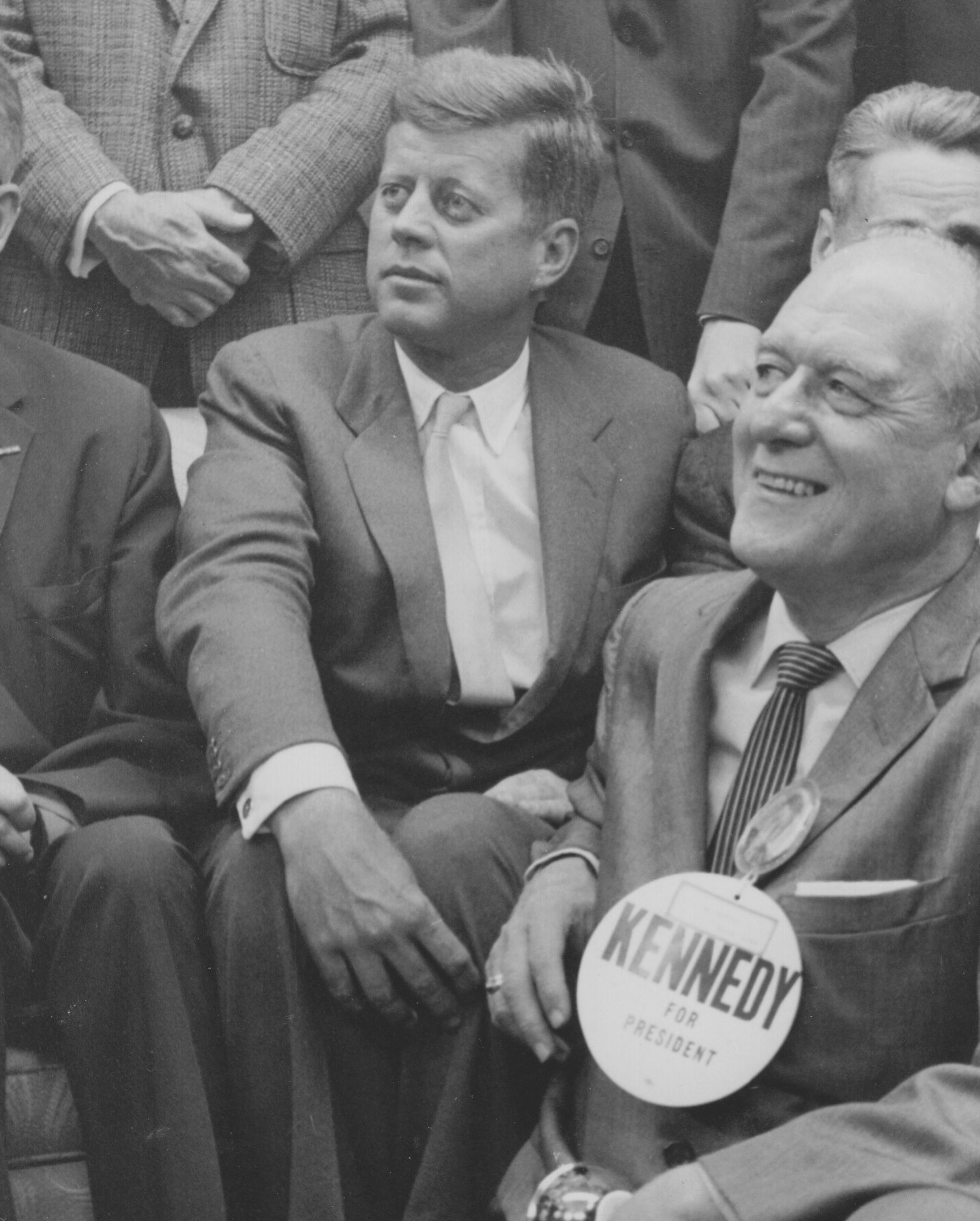
I also have a family connection to the book. Both my parents were political activists who volunteered for the Kennedy campaign.

My father attended the 1960 convention that is the highlight of the book’s opening chapters, and took the photos you see here. As a child, I got to accompany my mother to the Kennedy campaign headquarters in Chicago, where I was allowed to stamp the return address on stacks of envelopes.

Not so fast

If you’ve read any of my previous blog posts, you might be thinking, “Well, at least she isn’t talking about her new novel.”

Not so fast.

One element of LBJ’s legacy is, of course, his disastrous leadership of the war in Vietnam. And that war – specifically its lifelong impact on one woman who served – is the focus of my novel, Her Own Vietnam.

See how neatly I have twisted Caro’s award-winning masterpiece so it’s all about me?

You may well wonder what I know about the Vietnam War and its afterlife. More on that later.

Meanwhile, enjoy these photos of the past.

1960 Democratic Convention in Los Angeles. Photo by Julian P. Kanter.

1960 Democratic Convention in Los Angeles. Photo by Julian P. Kanter.


Candidate JFK at 1960 Democratic convention. Notice how big the campaign buttons are and how small the chairs. Photo by Julian P. Kanter.

Candidate JFK at 1960 Democratic convention. Notice how big the campaign buttons are and how small the chairs.
Photo by Julian P. Kanter.

Behind the Scenes in Book World

Photo by Kate Ter Haar

Photo by Kate Ter Haar

An update

It’s been three weeks since I sent the final draft of my novel, Her Own Vietnam, to my publisher for editing. While I wait to hear from her, there’s a lot for me to do.

Here are some of the things that are on my mind during this hidden gestation period as my manuscript evolves into a book.

Design

It’s not up to me to figure out cover images or page layout. A professional designer will do that, and my publisher will have the final word. But I am fortunate that Rosalie – unlike many publishers – actively engages her authors in design decisions and creative thinking about what the book should look like. So while I’m not worried about specific fonts or photos, I am thinking about the feeling I want the book cover to project – and hoping the designer can find a way to express that feeling visually.

Blurbs

Some readers study blurbs, some scorn them, but you’ve gotta have them. Two writers are currently considering blurb requests for my novel, and I’m working up the nerve to ask another well-known writer for a blurb. (Generally the publisher requests the blurbs, but in some cases the author might ask.)

As I mentioned in a previous post, it’s a delicate matter to ask someone to blurb your book. And like most people, I am uncomfortable asking for favors. The writer I’m about to approach has already been very generous to me. Is it over the top to ask her for yet more assistance? We’ll soon see.

Reviews

I suspect a novel like mine is going to find most of its readers through word of mouth. But the very first readers, particularly those who might stock the novel on their bookstore or library shelves, will most likely learn about it from reviews.

It is the publisher, not the author, who sends books out for review and Rosalie has already developed a list of review outlets for my novel. But I want to add to her list by learning about all the places I think my potential readers might hear about the book.

Who are my potential readers? Women (and men) who are interested in women’s stories. Who think about the human impact of social issues. Who fought in wars or marched against them, or both. Who are willing, for the length of a novel, to try on someone else’s life.

What about you?

I have three friends whose book recommendations are always on target. I have a couple of others whose stamp of approval for a book might as well be a skull and crossbones. 

What about you? How do you hear about books to read? Is it through a particular website or magazine? A local bookstore? A trusted friend? 

Do you have any advice for me about how to reach, well, people like you? Leave a comment and start the conversation: How will find your next book?

She’s leaving home

It’s official. I have sent the manuscript of Her Own Vietnam to my editor who, conveniently, is also my publisher, Rosalie Morales Kearns. An editor by profession, Rosalie is also a fantastic writer, author of the short story collection Virgins and Tricksters.

Sending her the book is the first step – and the first test – in the process of letting go. For a long time, I was the only one who obsessed about this novel. Now there will be two of us.

Three sharp red pencils.

My editor gets down to business. (Photo by Horia Varlan.)

(Please help me by singing in your head the Beatles song about “She’s leaving home after living alone for so many years.” You know the one.)

This begins a period of waiting to see what Rosalie thinks. But there’s plenty for a writer to do while the editor ponders her manuscript.

More on that soon.