30 Women Novelists You Should Know – #9 Masha Hamilton

In the waning days before my novel Her Own Vietnam is released, I’m writing about 30 Women Novelists You Should Know. Today – Masha Hamilton.

I know this isn’t fair

It’s not really fair to consider a novelist’s non-writing life when you think about her literary work. For example, we all know of highly lauded male writers who are famous for being misogynistic jerks in real life. (OK, I admit I don’t read those writers for that very reason.)

But with the novelist Masha Hamilton, it’s difficult for me to separate my admiration for her books from my admiration for the way she conducts her life.

 Are you tired yet?

She spent most of her career as a journalist, reporting from Afghanistan, Kenya, Moscow and the Middle East, among other places. She served as the Director of Communications and Public Diplomacy at the U.S. Embassy in Afghanistan. Now she works for Concern Worldwide, an NGO that seeks to eliminate extreme poverty around the world. In her spare time, Masha founded two world literacy projects, the Camel Book Drive in Kenya and the Afghan Women’s Writing Project.

Oh, and she’s written five acclaimed novels.

It’s true Masha Hamilton is a friend of mine. But c’mon, who could fail to be impressed by this level of literary and humanitarian accomplishment? Just reading about it makes me tired.

Oh, right – the books

Masha’s novels are Staircase of a Thousand Steps (2001), The Distance Between Us (2004), The Camel Bookmobile (2007), 31 Hours (2009) and What Changes Everything (2013), which has a wonderful book cover.

Her books deal with the vital issues of our time through the lens of compelling human stories. To enjoy the novels, you don’t need to know anything about the concerns she addresses – the lives of women in the Middle East, the toll of war on journalists and civilians, the challenge of spreading literacy in Kenya, the dangers of cultural naiveté, the lure of radicalism, the power of parental love. You can just let yourself be gripped by the plot, the suspense, the characters, and the tactile details that make you see, hear, smell and feel the locations, whether Afghanistan or Brooklyn.

I happen to be fond of books that persuade you toward a point of view. But Masha’s novels don’t do that.

They invite you instead to look behind all the warring points of view and find compassion for the striving, suffering human beings who are simply trying to do the best they can – for themselves, their families, their nations – with their one fleeting life.

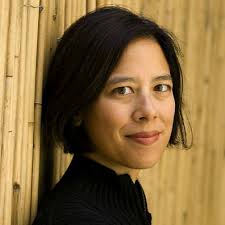
Masha Hamilton

Masha Hamilton

30 Women Novelists You Should Know – #8 Rene Denfeld

There are many more than 30 wonderful women novelists you should know. But there are only 36 days left until my novel, Her Own Vietnam, is released. So I’m using this time to talk about women storytellers, both new (to me) and vintage.

Having a Rene Denfeld moment

There was a time, not all that long ago, when I had never heard of Lana del Ray. Then suddenly her name and her music were everywhere: on the radio, on TV, playing in friends’ cars, showing up on Facebook.

I’m having that kind of a moment with Rene Denfeld. First I started seeing rapturous reviews for her novel, The Enchanted. Later I came across this powerful article by Denfeld.

Beautiful, strange and stirring

One night I started to read her novel. The next morning a comment from her appeared in my Facebook feed. (Apparently we have friends in common.)

If you’ve read the beautiful, strange and stirring novel The Enchanted, you will understand how disconcerting it was to have the creator of that hallucinatory universe pop up on Facebook.

The Enchanted takes place largely in an old stone prison, inside a basement dungeon that serves as the prison’s death row. The narrator, Arden, is waiting his turn to die for a crime so horrific he will not describe it.

Even The Lady, the intrepid death row investigator who is the novel’s main character, walks a little faster when she passes his cell. Her job is to find evidence that will get a prisoner’s death sentence commuted to life in prison. But her current client, a murderer named York, is different from all the rest. He wants to die.

Not the standard ingredients

An unnamed investigator with her own troubled past, a fallen priest, a heartbroken warden, a clutch of death row inmates, and a narrator who is a condemned murderer and is certainly twisted if not mad – these are not the usual ingredients for a thing of beauty. And yet the novel is beautiful. Open the book anywhere at random, and you’ll find an idea, a description, a piece of dialogue that is fresh and lovely.

The Enchanted is not one of those novels where you turn the last page and lament the need to leave the world it created. You rejoice at your freedom to leave that “enchanted place.” But you have learned to see that world in an entirely new way.

Rene Denfeld

Rene Denfeld

30 Women Novelists You Should Know – #5 Susan Choi

Only a few weeks to go before my novel Her Own Vietnam is published, and still many fabulous women novelists to discuss. Moving in alphabetical order, today it’s Susan Choi.

We think we know this story – but we don’t

Susan Choi explores events, situations or characters that we think we know and upends them, making them both less familiar and more illuminating of life in America. Her characters are sometimes unlikeable but always compelling, and Choi’s psychological insights penetrate even the most complicated characters.

I became a Susan Choi fan after reading American Woman, published in 2003. The novel uses some elements of the well-known Patty Hearst saga – a young heiress is kidnapped by left-wing radicals and comes to join them – and melds them into a story we’ve never read before.

Choi’s focus is not on the Patty Hearst figure, but on the woman no one notices, a revolutionary of Japanese-American descent who agrees to hide the heiress and ultimately grows to love her, all the while knowing that it is she herself – not white, not rich, not recognized as fully American – who is the most at risk. The novel was a finalist for the Pulitzer Prize.

The power of otherness

A Person of Interest (2008) is based loosely on an amalgam of two real-life stories: the Unabomber saga, and the scientist whose life was destroyed unfairly when he was announced as a person of interest in the anthrax case. In the novel, a mathematician named Lee is nearing retirement at a Midwestern university. He is envious of his young, popular neighbor in the faculty offices – until the man opens a package that contains a bomb. Lee ultimately becomes a person of interest in the case. The novel is part mystery, part procedural, but mostly a detailed, thoughtful exploration of life as a perpetual outsider.

In My Education (2013), a graduate student is powerfully drawn to her glamorous professor. It’s a timeworn literary trope, but with a writer of Choi’s skill and originality, nothing is quite what you expect. To start with, the student ends up falling in love not with her professor, but with his wife.

The dynamics of race, gender, ethnicity, class and culture – the very definition of “otherness” – play central roles in her work. With the sure hand of an expert storyteller, Susan Choi takes on the unpopular, the unsayable, and the deeply intriguing.

Susan Choi

Susan Choi

30 Women Novelists You Should Know – #3 Octavia Butler

You would think that writing novels might sate your appetite for reading them, but I’ve found the opposite to be true. There seem to be countless numbers of novelists out there, writing dazzling books.

As the November 1 publication date approaches for my own novel, Her Own Vietnam, I’m writing about 30 of my favorite women novelists. I dare you to read their books and not become a fan.

The majesty and mystery of Octavia Butler

First, that name. Octavia Butler. There’s majesty and mystery to it. Someone knew something when that child was born. And that makes sense, because Octavia Butler’s books are full of people who have special ways of knowing.

You could call her a science fiction writer, although I don’t actually think of her that way. I think her books ask the universal question of all fiction: “What if?”

However, she certainly swept the top literary awards for science and fantasy fiction, winning both the Nebula and Hugo awards – twice.

Octavia Butler wrote 12 novels that comprised three different series, and two additional stand-alone novels. Many of these books unfold in worlds different from our own, with characters that are not strictly human.

Creating new worlds and reshaping familiar ones

Her most famous novel, Kindred, takes place in a completely familiar world. It has one small wrinkle, though: the main character, a young African American woman, keeps being flung back in time to a plantation in rural Maryland. There she is both enslaved and entrusted with a mission to save the future, including her own.

I am not a big fan of science fiction or fantasy, but I am a fan of Octavia Butler. Her books create other universes that serve as mirrors to examine what is most human in us. How do we understand and respond to race, gender, otherness? What makes a family? What is the purpose of power? How thin is the line between what we know and what we fear?

Fearless

Octavia Butler herself seemed fearless. As an African American woman and a lesbian, she broke new ground and demanded respect in the predominantly white, male field of science fiction. She was the first writer in that genre to win a MacArthur Fellowship, which we all secretly think of as a genius grant.

She was an imposing woman, 6 feet tall, yet shy and introverted, according to her own description. I had the privilege of hearing her speak several months before her death in 2006, and she was witty and humble as she addressed an adoring, standing-room-only audience.

Octavia Butler died at 58. Who knows where else she might have taken us with her words?

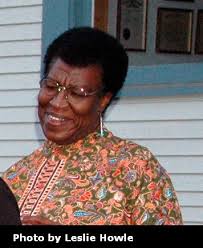
Octavia Butler (Photo by Leslie Howle)

Octavia Butler
(Photo by Leslie Howle)


30 Women Novelists You Should Know – #2 Kim Barnes

These days I’m writing about Thirty Women Novelists You Should Know. In alphabetical order, today is #2: Kim Barnes.

Turns out I didn’t discover her

Like many writers I believe I’ve discovered, Kim Barnes had a distinguished writing career long before I stumbled upon her work. For instance, her first memoir was nominated for a Pulitzer Prize. I’ve read only one of her three novels, but loved it enough to know I want to read more of her books – and to introduce other readers to her if I can.

In the Kingdom of Men is about a young couple from Pawnee, Oklahoma who move to Saudi Arabia in the 1960s so the husband can work for an American oil company. The wife, who grew up in poverty under a strict Pentecostal religion, suddenly has an Indian houseboy and a Bedouin driver, and nothing to do but chafe under the familiar restrictions the Saudis place on women. The novel does a wonderful job of creating characters and exploring the many political, racial and gender issues at play in the burgeoning oil partnership between the U.S. and the Saudis.

We all live in a dangerous neighborhood

I was first drawn to the book by its title, since I believe we are all living in the kingdom of men and it’s a dangerous neighborhood. The novel captured me with its vibrant depiction of the American oil companies’ frantic efforts to domesticate the Saudi landscape and people, as well as the book’s examination of the dangers – and temptations – of empire.

The main character, Gin, is complicated and compelling, always probing to find the limits of her freedom. As a reader you fear for her, cheer for her, and wish she could live in a less confining era. The novel brilliantly illuminates conflicts of culture – not only the tensions between the Saudis and the Americans who live in guarded compounds on their land, but the tensions between democracy and the rampaging capitalism of the oil companies. And I particularly loved how friendship served in the novel as both a means of redemption and insurrection.

I’m stealing this

On Barnes’ website, the discussion guide for In the Kingdom of Men concludes with this odd and thought-provoking question, which I am absolutely going to steal for my own discussion guide for Her Own Vietnam: “If you could save one life in this story, whose life would it be?”

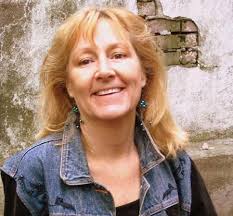
Kim Barnes

Kim Barnes